
Whether you’re a Bangladeshi student aiming for prestigious universities in the USA, UK, Canada, or Australia, your SOP is your voice in the application process. It’s where you transform grades and test scores into a compelling narrative about who you are, what drives you, and why you’re the perfect fit for a specific program.
In this comprehensive guide, you’ll discover the exact framework used by thousands of successful applicants to craft SOPs that open doors to their dream universities. From real examples and country-specific requirements to downloadable templates and expert editing tips, everything you need is right here.
Understanding Statement of Purpose: Definition and Core Purpose
What is a Statement of Purpose?
A Statement of Purpose (SOP) is a formal essay required by most graduate programs that explains your academic background, professional experience, research interests, career goals, and reasons for choosing a specific program and university. Think of it as your personal pitch to the admissions committee—your opportunity to stand out from hundreds or thousands of applicants with similar qualifications.
Unlike transcripts that show what you’ve achieved or recommendation letters that convey what others think of you, your SOP is where you directly communicate your story, motivations, and vision to the decision-makers who will determine your academic future.
The typical SOP answers five critical questions:
- Who are you? (Academic and professional background)
- Why this field? (Motivation and passion for the subject)
- Why this program? (Specific fit with university offerings)
- Why you? (Unique qualifications and perspectives)
- What’s next? (Career goals and how the program enables them)
SOP vs. Personal Statement vs. Letter of Intent: Understanding the Differences
Many applicants confuse these three documents. Here’s how they differ:
| Aspect | Statement of Purpose (SOP) | Personal Statement | Letter of Intent |
|---|---|---|---|
| Focus | Academic/professional background, research interests, career goals | Personal experiences, character development, life challenges | Commitment to a specific program or professor |
| Tone | Formal, achievement-oriented | Reflective, narrative-driven | Enthusiastic, direct |
| Content | Program fit, research alignment, specific faculty | Personal growth, values, diversity contribution | Why this program is your first choice |
| Length | 500-1000 words typically | 500-750 words typically | 250-500 words typically |
| Common for | Graduate programs (MS, PhD) | Undergraduate, some graduate programs | Waitlist responses, final round admissions |
Why Universities Require SOPs in Graduate Admissions
Admissions committees receive applications from candidates with impressive GPAs, high test scores, and strong recommendation letters. So why do they need your SOP? Here’s what they’re really evaluating:
1. Writing and Communication Skills Graduate programs require extensive research, paper writing, and presentations. Your SOP demonstrates whether you can articulate complex ideas clearly and persuasively—a skill you’ll use throughout your academic career.
2. Genuine Interest and Motivation Anyone can apply to a program, but your SOP reveals whether you’ve done your homework. Do you understand what the program offers? Can you articulate why you’re passionate about this field? Generic SOPs are immediately spotted and often rejected.
3. Research Fit and Academic Readiness For research-based programs especially, universities want to know if your interests align with faculty expertise and available resources. Your SOP shows whether you understand the academic landscape and how you’ll contribute to it.
4. Future Potential and Career Vision Universities invest in students who will succeed and bring prestige to the institution. Your SOP demonstrates whether you have clear goals and a realistic plan—not just dreams, but actionable vision.
5. Diversity of Perspective Admissions committees build cohorts, not just admit individuals. Your SOP reveals the unique perspective, experiences, and backgrounds you’ll bring to classroom discussions and research collaborations.
6. Cultural and Program Fit Beyond academics, will you thrive in this specific environment? Your SOP helps admissions officers assess whether your values, work style, and expectations align with the program’s culture.
The Role of SOP in 2026 Graduate Admissions
The landscape of graduate admissions continues to evolve, and in 2026, SOPs have become even more critical:
Holistic Admissions Emphasis: Many top universities have moved toward holistic review processes, reducing the weight of standardized test scores. A 2025 study by the Council of Graduate Schools found that 78% of programs now consider the SOP equal to or more important than GRE scores.
AI Detection Awareness: With the rise of AI writing tools, admissions committees have become more sophisticated in detecting authentic voices. SOPs that feel genuine, specific, and personal stand out more than ever. Universities are specifically training reviewers to identify AI-generated content and overly templated submissions.
International Student Considerations: For Bangladeshi and other international students, the SOP has additional importance. It demonstrates English language proficiency, cultural awareness, and the ability to articulate why studying abroad makes sense for your specific goals—addressing implicit questions about visa intent and post-graduation plans.
Research Alignment Priority: Especially for PhD programs, the emphasis on research fit has intensified. Programs want to see that you’ve done thorough research on faculty members, current projects, and how your interests align with available resources.
According to Dr. Sarah Mitchell, Director of Graduate Admissions at a top-ranked US university: “We can teach students the technical content, but we can’t teach passion, curiosity, or genuine fit. The SOP is where we discover these qualities. A well-crafted SOP can compensate for a slightly lower GPA, but a poor SOP can sink an otherwise strong application.”
The bottom line: Your SOP is not just another form to fill out – it’s your most powerful tool to differentiate yourself and make a compelling case for admission.
How to Write Your SOP: Step-by-Step Process
Writing a compelling Statement of Purpose isn’t about inspiration striking at midnight. It’s a systematic process that transforms your experiences, achievements, and aspirations into a narrative that admissions committees can’t ignore.
Here’s the proven framework used by thousands of successful applicants.
Phase 1: Pre-Writing Research & Brainstorming (Time Required: 2-3 weeks)
Before writing a single word, invest time in deep research and self-reflection. This groundwork makes the actual writing process 10x easier and your final SOP 10x stronger.
University & Program Research Checklist
For each university on your list, research:
✅ Program specifics
✅ Faculty research
✅ Resources and facilities
✅ Student life and culture
✅ Practical considerations
Create a research document for each university with specific details you’ll reference in your SOP. This prevents you from accidentally mentioning the wrong professor or program feature.
Self-Reflection Questions
Set aside time for deep thinking about these questions. Write detailed answers—these become the raw material for your SOP.
- About your journey
- About your goals
- About program fit
Document everything. You won’t use all of it, but having comprehensive notes makes the writing process smoother and helps you identify the strongest material.
Phase 2: Planning Your Content Structure (Time Required: 1-2 days)
With research complete and self-reflection done, it’s time to organize your material into a coherent structure.
Creating Your SOP Outline
A strong SOP follows a logical flow that builds your case paragraph by paragraph. Here’s a proven structure:
PARAGRAPH 1: Hook/Opening (75-100 words)
PARAGRAPH 2: Academic Journey (150-200 words)
PARAGRAPH 3: Professional/Research Experience (150-200 words)
PARAGRAPH 4: Why Graduate School & Research Interests (125-150 words)
PARAGRAPH 5: Why This Program & University (175-225 words)
PARAGRAPH 6: Career Goals (100-125 words)
PARAGRAPH 7: Conclusion (75-100 words)
Total: 850-1,100 words
Phase 3: Writing the First Draft (Time Required: 1-2 weeks)
Now comes the actual writing. Here’s the secret: your first draft should be terrible. Give yourself permission to write poorly, knowing you’ll revise multiple times.
Crafting a Compelling Opening
Your opening paragraph is the most important 100 words you’ll write. Admissions officers read hundreds of SOPs—a strong opening determines whether they’re engaged or just checking boxes.
What works:
✅ Specific anecdote:
✅ Surprising insight or statistic:
✅ Provocative question or statement:
What doesn’t work:
❌ Generic childhood story:
❌ Obvious statement:
❌ Dictionary definition:
❌ Overly grandiose:
Writing a Memorable Conclusion
Your conclusion should tie everything together and leave a lasting impression.
Phase 4: Reviewing & Refining (Time Required: 2-3 weeks)
Great SOPs are rewritten, not written. Plan for 5-8 revision cycles minimum.
Self-Editing Checklist
- Content review
- Style review
- Technical review
Professional Editing Services
When to invest in professional help:
- English is not your first language
- You’re targeting highly competitive programs (top 20 universities)
- Your writing isn’t your strength
- You want objective, expert feedback
- Deadlines are approaching and you need efficient revision
What professional editors provide:
- Grammar, spelling, and syntax perfection
- Structural improvements and flow enhancement
- Content strengthening suggestions
- Cultural context and tone adjustments
- Field-specific insights (if they specialize in your area)
- Final proofreading and polishing
MMS Global Services editors have helped over 1000+ Bangladeshi students secure admissions to top universities worldwide. We understand both international expectations and the unique strengths of Bangladeshi applicants. Our SOP editing includes:
- Comprehensive content review with detailed feedback
- Line-by-line editing for clarity and impact
- Multiple revision rounds until you’re satisfied
- Guidance on country-specific requirements
- Fast turnaround (48-72 hours)
Book a Free SOP Consultation →
Country-Specific SOP Requirements
While the core components of a strong SOP remain consistent, different countries—and even individual universities within those countries—have distinct expectations, emphases, and cultural norms. Understanding these nuances can make the difference between acceptance and rejection.
As a Bangladeshi student applying internationally, you’ll encounter varying requirements across your target destinations. Here’s what you need to know for each major study destination.
| Aspect | USA | UK | Canada | Australia |
|---|---|---|---|---|
| Length | 800-1,000 words | 600-700 words (4,000 chars) | 800-1,200 words | 500-1,000 words |
| Primary Focus | Research fit, faculty alignment | Academic background, career goals | Research + career + diversity | Career goals, GTE, return plans |
| Faculty Mentions | 2-3 professors (detailed) | 1-2 professors (brief) | 1-2 professors (moderate detail) | Optional, focus on program |
| Tone | Professional but personal | Formal, academically rigorous | Warm, professional | Straightforward, honest |
| Immigration Concerns | Moderate (F-1 visa intent) | Moderate (Genuine Student) | High (study permit scrutiny) | Very High (GTE requirement) |
| Return Plans | Implicit, don’t over-emphasize | Mention briefly | Address clearly | Explicitly detailed |
| Research Emphasis | Very High (PhD), Moderate (MS) | Moderate-High | High | Moderate |
| Career Goals | Important but secondary | Important | Very Important | Critical |
| Unique Considerations | Independence, innovation, contribution | Academic rigor, module selection | Diversity, Canadian context | GTE, ties to home, practical focus |
Real SOP Examples with Expert Analysis
Reading strong SOPs is one of the best ways to understand what works. Here are three annotated examples showing different programs and approaches. Each example is analyzed with expert commentary explaining why specific elements are effective.
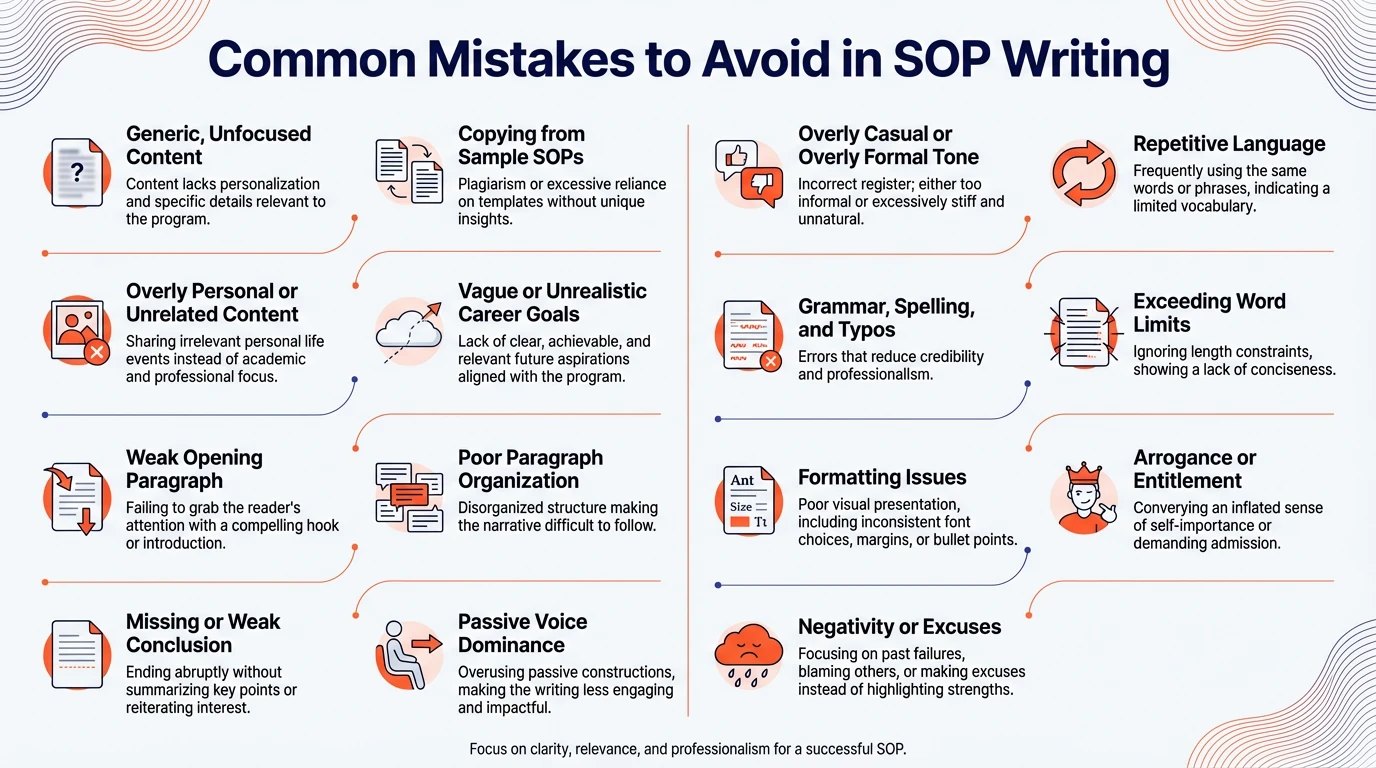
Common Mistakes to Avoid in SOP Writing
Even strong applicants can sabotage their chances with avoidable SOP mistakes. Here are the most common errors that lead to rejections – and how to avoid them.
Frequently Asked Questions About Writing SOP
Conclusion
Writing a Statement of Purpose that secures admission to your dream university isn’t about luck—it’s about strategy, authenticity, and effective communication. Your dream university is waiting. Your perfect SOP starts today. Let’s make it happen together.