
Canada remains the top study destination for Bangladeshi students — and for good reason. World-class universities, post-study work pathways, and one of the clearest routes to permanent residency make it unbeatable. But 2026 brings the most significant changes to Canada’s study permit system in years, and your application strategy must reflect them.
This guide covers everything: the new 2026 permit cap, the Provincial Attestation Letter (PAL) requirement, updated financial proof rules, the step-by-step application process, and expert advice from MMS Global’s counsellors who have helped hundreds of Bangladeshi students reach Canada.
Updated April 2026 — all data reflects current IRCC policies.
2026 CRITICAL UPDATE: Canada has cut new study permit spots by nearly 50% — only 155,000 new arrivals allowed in 2026. Undergraduate and diploma applicants now need a Provincial Attestation Letter (PAL) before applying. Master’s and PhD students at public universities are EXEMPT. Start your application early.
Why Bangladesh Students Choose Canada in 2026
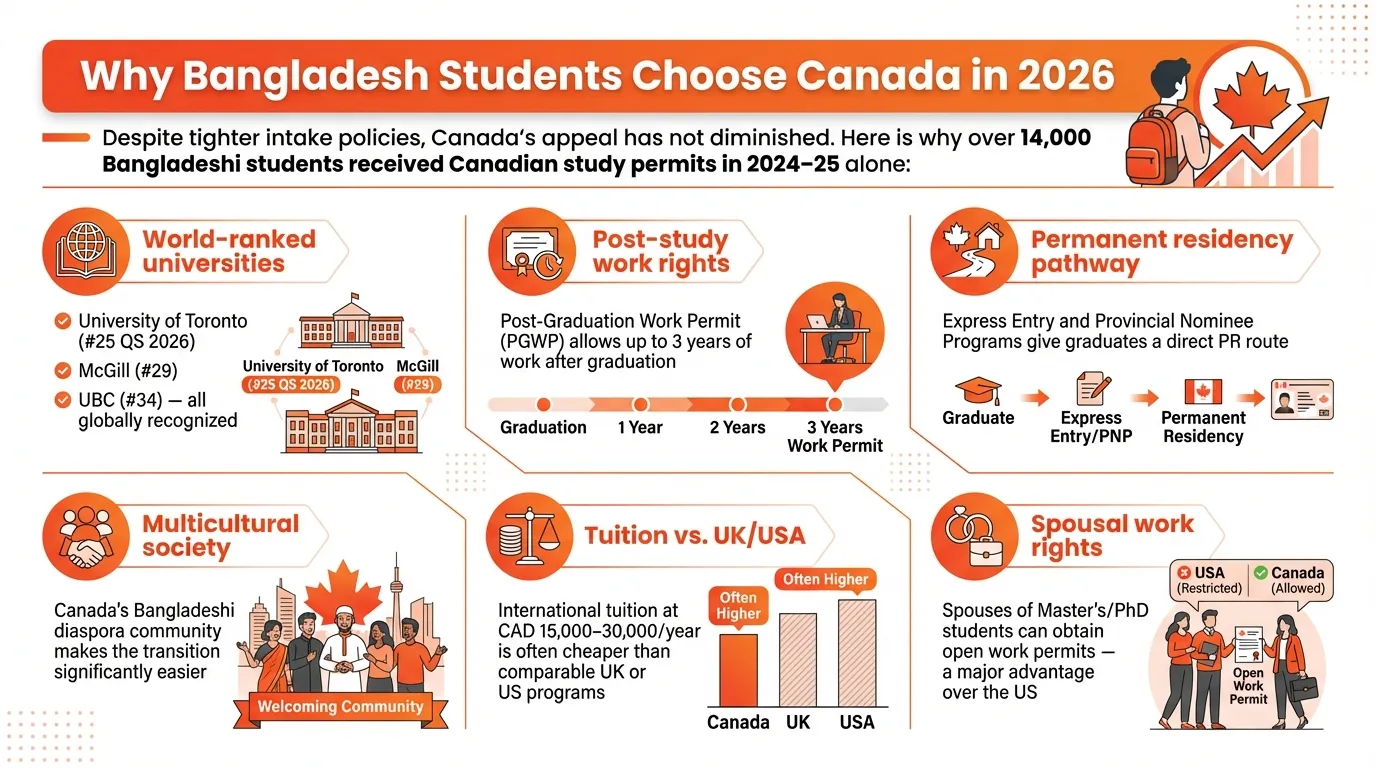
Despite tighter intake policies, Canada’s appeal has not diminished. Here is why over 14,000 Bangladeshi students received Canadian study permits in 2024–25 alone:
- World-ranked universities: University of Toronto (#25 QS 2026), McGill (#29), UBC (#34) — all globally recognized
- Post-study work rights: Post-Graduation Work Permit (PGWP) allows up to 3 years of work after graduation
- Permanent residency pathway: Express Entry and Provincial Nominee Programs give graduates a direct PR route
- Multicultural society: Canada’s Bangladeshi diaspora community makes the transition significantly easier
- Tuition vs. UK/USA: International tuition at CAD 15,000–30,000/year is often cheaper than comparable UK or US programs
- Spousal work rights: Spouses of Master’s/PhD students can obtain open work permits — a major advantage over the US
2026 Study Permit Updates You Must Know
The Canadian government has restructured its international student program significantly. Ignoring these changes is the number one reason applications get rejected or delayed in 2026.
1. National Study Permit Cap (2026)
Canada will issue a maximum of 408,000 study permits in 2026 — 7% fewer than 2025 and 16% fewer than 2024. Of these, only 155,000 are available to newly arriving international students (down from 305,900 in 2024).
| Year | Total Target | New Arrivals | Change |
|---|---|---|---|
| 2024 | 485,000 | 305,900 | — |
| 2025 | 437,000 | ~240,000 | -10% |
| 2026 | 408,000 | 155,000 | -49% for new arrivals |
What this means for you: Competition for undergraduate and diploma study permits is fierce. Apply early, prepare flawless documents, and choose your DLI strategically.
2. Provincial Attestation Letter (PAL) — New Mandatory Requirement
Most undergraduate and diploma applicants must now obtain a Provincial Attestation Letter (PAL) from the province where their DLI is located before applying for a study permit.
How PAL works:
- Your chosen DLI (Designated Learning Institution) applies for a PAL allocation from their province
- The province issues the PAL to the DLI, which passes it to you
- You include the PAL in your study permit application to IRCC
- Without a valid PAL, IRCC will not process your application
PAL exemptions — you do NOT need a PAL if you are:
- Enrolling in a Master’s or PhD program at a PUBLIC Canadian university (effective January 1, 2026)
- A K-12 (primary/secondary) student
- Renewing your study permit at the same DLI and same level of study
- In a Canadian government priority group
Always confirm your DLI has PAL allocation availability BEFORE accepting admission. MMS Global counsellors verify this as part of the application process.
3. Master’s and PhD Fast-Track Exemption (January 2026)
Graduate students are the clear winners of Canada’s 2026 policy shift. Here is what changed:
| Feature | Undergraduate/Diploma | Master’s (Public DLI) | PhD (Public DLI) |
|---|---|---|---|
| Study permit cap | Subject to cap | EXEMPT | EXEMPT |
| PAL/TAL required | Yes | No | No |
| Processing time | ~8–12 weeks | ~4–6 weeks | ~14 calendar days |
| Spouse work permit | No | Yes (open work permit) | Yes (open work permit) |
Considering a Master’s program in Canada? Read our complete guide to Study in Canada →
Canada Student Visa Types: Study Permit vs. TRV
Bangladeshi students need two documents to study in Canada:
| Document | Purpose | Who Issues It | Validity |
|---|---|---|---|
| Study Permit | Authorizes you to study at a DLI in Canada | IRCC (Canada) | Duration of program + 90 days |
| Temporary Resident Visa (TRV) | Allows you to enter Canada | IRCC (Canada) | Usually 1–10 years, multiple entry |
IRCC automatically issues the TRV alongside your study permit if you are eligible. You do not need to apply for them separately.
Eligibility Requirements for Bangladeshi Students
To be eligible for a Canadian study permit as a Bangladeshi student, you must:
- Valid passport — at least 6 months validity beyond your planned stay in Canada
- Letter of Acceptance (LOA) from a Designated Learning Institution (DLI) in Canada
- Provincial Attestation Letter (PAL) — for most undergraduate/diploma programs
- Proof of financial support — minimum CAD $20,635 for first year (see financial section below)
- English language proficiency — IELTS 6.0–6.5 or equivalent (TOEFL, PTE, Duolingo)
- Statement of Purpose (SOP) — explaining your educational and career goals
- Police clearance certificate from Bangladesh
- Medical examination by an IRCC-approved panel physician
- Proof of ties to Bangladesh — evidence you intend to return after study
Financial Requirements and Proof of Funds (2026)
Updated 2026 Requirement: The Canadian government raised the minimum cost-of-living requirement to CAD $20,635 per year (approximately BDT 18,50,000 at current exchange rates) — double the 2023 threshold of CAD $10,000.
| Household Composition | Minimum Required (CAD/year) | Approx. BDT |
|---|---|---|
| Student alone | CAD 20,635 | ~BDT 18,50,000 |
| Student + spouse/partner | CAD 25,690 | ~BDT 23,10,000 |
| Student + 1 child | CAD 25,690 | ~BDT 23,10,000 |
| Student + spouse + 1 child | CAD 30,750 | ~BDT 27,60,000 |
| Quebec (student alone) | CAD 24,635 | ~BDT 22,10,000 |
Note: You must show funds covering both the above living expenses AND your full tuition fees. For a CAD $20,000/year undergraduate program, total proof of funds required is typically CAD $40,000–45,000 for the first year.
Acceptable Proof of Funds
| Fund Type | Requirement | Visa Officer Acceptance |
|---|---|---|
| Guaranteed Investment Certificate (GIC) | CAD $20,635 in Canadian bank — blocked account | Highest (95–98%) |
| Education loan (Bangladeshi bank) | Letter from scheduled bank, full tuition + living costs | High (85–90%) |
| Sponsor bank statement (parents) | 6-month history, consistent balance, source of income shown | Moderate (75–80%) |
| Scholarship letter | Official award letter from institution or government | High (90%+) |
| Combination of above | Total must meet threshold across all documents | Depends on documents |
Need help preparing your financial documents? Book a free counselling session with MMS Global →
Document Checklist for Canada Student Visa (2026)
Use this checklist to prepare your application. Missing even one document is among the top reasons for refusal.
Mandatory Documents
- Valid Bangladeshi passport (minimum 6 months validity beyond program end date)
- Letter of Acceptance (LOA) from a Canadian DLI — must be on official letterhead, include program name, start date, and DLI number
- Provincial Attestation Letter (PAL) — obtain from your DLI for undergraduate/diploma programs
- IMM 1294 — Application to Study in Canada (completed online via IRCC portal)
- Proof of funds — bank statements, GIC confirmation, loan letter, or scholarship award
- Statement of Purpose (SOP) — 1–2 pages; explain why Canada, why this program, your career goals, and why you will return to Bangladesh
- Police Clearance Certificate (PCC) from Bangladesh Police Headquarters (Rajarbagh, Dhaka)
- Medical examination report from IRCC-approved panel physician in Bangladesh
- Passport-sized photographs — recent, white background, as per IRCC specifications
- Biometrics — fingerprints and photo at VFS Global Bangladesh
Additional Documents (Where Applicable)
- Academic transcripts (HSC, SSC, Bachelor’s — certified copies)
- English proficiency test result (IELTS, TOEFL, PTE, Duolingo English Test)
- Previous Canadian or foreign visa (if any — include refusals)
- Employment/experience letter (for professional programs)
- Marriage certificate (if bringing spouse)
- GIC confirmation letter (if using GIC for funds)
Need help with SOP writing? MMS Global’s experts prepare winning Statements of Purpose →
English Language Requirements
| Test | Undergraduate Minimum | Postgraduate Minimum | Notes |
|---|---|---|---|
| IELTS Academic | 6.0 overall (no band < 5.5) | 6.5 overall (no band < 6.0) | Most widely accepted in Canada |
| TOEFL iBT | 80–90 | 90–100 | Check university-specific cutoff |
| PTE Academic | 58–65 | 65–75 | Fast results (24–48 hrs) |
| Duolingo English Test | 110–120 | 120–130 | Accepted by select universities |
| CELPIP General | 7–9 (CLB 8) | 9–10 (CLB 9) | Canada-specific test |
Medical Examination Requirements
All Bangladeshi students applying for a Canadian study permit of 6 months or more must complete a medical examination with an IRCC-approved panel physician.
Approved Medical Centers in Bangladesh (2026)
| Medical Center | Location | Working Hours |
|---|---|---|
| Green Crescent Health Service | Dhaka | Sun–Thu: 9:00 AM – 4:00 PM |
| Migration Health Assessment Center (MHAC) | Dhaka | Sun–Thu: 9:00 AM – 4:00 PM |
| Wahab Medical | Dhaka | Sun–Thu: 9:00 AM – 4:00 PM |
| Applicant | Medical Exam Fee (BDT) |
|---|---|
| Adult (15 years and above) | BDT 7,000 – 8,000 |
| Child (11–14 years) | BDT 5,000 |
| Child (under 11 years) | BDT 4,500 |
The medical exam includes: full physical examination, chest X-ray, blood tests, vision and hearing checks. Results are submitted electronically to IRCC’s Regional Medical Officer in New Delhi. Children under 16 must be accompanied by a parent or guardian.
Step-by-Step Application Process
Step 1: Choose Your Program and DLI
Confirm PAL availability: Contact your chosen DLI’s international admissions office to confirm they have PAL allocation space for your program intake before accepting the offer.
Step 2: Receive Letter of Acceptance (LOA)
Apply for admission and receive your official LOA from the DLI. This document is the foundation of your visa application.
Step 3: Obtain Provincial Attestation Letter (PAL)
Your DLI will initiate the PAL process with their provincial authority. This can take 2–6 weeks — factor this into your application timeline.
Step 4: Prepare Financial Documents
Ensure your funds are in order. Open a GIC (Guaranteed Investment Certificate) with a Canadian bank like Scotiabank or RBC, or gather 6-months’ bank statements from your sponsor.
Step 5: Book and Complete Medical Examination
Visit an IRCC-approved panel physician in Bangladesh. Results are uploaded directly to IRCC — you receive a medical reference number.
Step 6: Create IRCC Account and Apply Online
Visit and create a secure account. Complete form IMM 1294 with full accuracy. Upload all documents, pay the application fee (CAD $150 + CAD $85 biometrics), and submit.
Step 7: Submit Biometrics at VFS Global Bangladesh
2026 VFS Update: From March 7, 2026, you must upload your Biometric Instruction Letter (BIL) to the VFS portal BEFORE booking your biometric appointment. New service charges also apply from May 1, 2026. Visit for the latest fee and booking information.
VFS Global Canada Visa Application Centers in Bangladesh:
- Dhaka (Primary Center) — visa.vfsglobal.com/bgd/en/can/
- Chittagong
- Sylhet
Step 8: Track and Await Decision
Monitor your IRCC account for correspondence. Respond promptly to any additional document requests. Processing typically takes 4–12 weeks for most Bangladeshi applicants.
Processing Time and Fees (2026)
| Application Type | Processing Time | Government Fees (CAD) |
|---|---|---|
| Study Permit (standard) | 8–12 weeks | CAD $150 |
| Study Permit — Master’s | 4–6 weeks | CAD $150 |
| Study Permit — PhD (fast-track) | ~14 calendar days | CAD $150 |
| Biometrics | Same day at VFS | CAD $85 |
| Medical Exam | 1–2 days (results to IRCC) | BDT 7,000–8,000 |
Total estimated government fees: CAD $235 (study permit + biometrics), not including medical exam, courier charges, or consultancy fees.
Top Canadian Universities for Bangladeshi Students (QS 2026)
| University | QS World Ranking 2026 | Province | Known For |
|---|---|---|---|
| University of Toronto | #25 | Ontario | Engineering, Medicine, Business, AI Research |
| McGill University | #29 | Quebec | Medicine, Law, Sciences, Arts |
| University of British Columbia (UBC) | #34 | British Columbia | Sustainability, Forestry, Tech, MBA |
| University of Alberta | #96 | Alberta | Energy, Engineering, Business |
| University of Waterloo | #122 | Ontario | Computer Science, Co-op Programs, Engineering |
| McMaster University | #189 | Ontario | Health Sciences, Engineering, Business |
| University of Calgary | #201 | Alberta | Energy, Business, Engineering |
Post-Study Work Opportunities in Canada
The Post-Graduation Work Permit (PGWP) is one of the most compelling reasons Bangladeshi students choose Canada. It allows you to work in Canada for up to three years after graduating — gaining real Canadian work experience that feeds directly into Express Entry for permanent residency.
PGWP Eligibility (2026 Update)
- Program length: Minimum 8-month full-time program at a DLI
- GPA requirement: Minimum 3.0 GPA (new 2026 rule — ensures PR-track quality)
- Application window: Must apply within 180 days of receiving your final grades letter
- Work permit length: Matches program length; maximum 3 years for programs of 2+ years
- Work hours during study: Up to 20 hrs/week during semesters; full-time during breaks
| Industry Sector | Average Annual Salary (CAD) | Demand Level in 2026 |
|---|---|---|
| Information Technology / AI | CAD 70,000 – 130,000 | Very High |
| Engineering (Civil, Mechanical, Electrical) | CAD 65,000 – 120,000 | High |
| Healthcare (Nursing, Allied Health) | CAD 60,000 – 110,000 | Very High |
| Finance and Accounting | CAD 55,000 – 100,000 | High |
| Data Science / Analytics | CAD 75,000 – 130,000 | Very High |
| Business Management / MBA | CAD 60,000 – 110,000 | Moderate–High |
Already planning post-graduation work? Read our full guide on Post-Study Work Visa in Canada →
Common Reasons for Canada Student Visa Refusal
Understanding why applications are refused is as important as knowing the requirements. Here are the most common reasons Bangladeshi student visa applications get rejected:
- Insufficient proof of funds — The single biggest refusal reason. Inconsistent bank statements, recent large deposits with no explanation, or total funds below the CAD $20,635 threshold.
- Weak ties to Bangladesh — Visa officers must believe you will return after study. No family dependents, no employment prospects, no property ties = higher refusal risk.
- Weak Statement of Purpose — Generic SOPs that don’t clearly justify why Canada, why this specific program, and how it aligns with your career goals in Bangladesh.
- Missing PAL — Submitting applications for undergraduate programs without a valid Provincial Attestation Letter (new 2024–2026 requirement).
- Previous refusals not disclosed — Hiding previous visa refusals (any country) is grounds for permanent inadmissibility.
- Acceptance letter issues — LOA from institutions that are not active DLIs, or LOAs with missing program information.
- Medical exam expired — Medical results are valid for 12 months. Applying after expiry requires a repeat exam.
- Mismatched documents — Name spelling inconsistencies across passport, LOA, and bank statements raise fraud flags.
MMS Global’s Success Strategy: Our counsellors conduct a pre-submission document review to catch these issues before they reach the visa officer. We’ve maintained a consistently high Canada visa approval rate because prevention beats appeal every time.
Scholarships for Bangladeshi Students in Canada
Reducing the cost of studying in Canada is possible through scholarships — and having a scholarship letter strengthens your financial proof significantly.
| Scholarship | Who Can Apply | Value (CAD) | Deadline |
|---|---|---|---|
| Vanier Canada Graduate Scholarship | PhD students | Up to CAD $50,000/year | October annually |
| Ontario Graduate Scholarship (OGS) | Master’s & PhD, Ontario universities | CAD $10,000–15,000 | Varies by university |
| University of Toronto Scholarships | Undergraduate and graduate | CAD $5,000–35,000 | Varies by program |
| UBC International Major Entrance Scholarship | Undergraduate (1st year) | CAD $20,000–40,000 | February annually |
| McGill University Scholarships | Graduate programs | CAD $3,000–20,000 | Varies by program |
| Shastri Indo-Canadian Institute | South Asian graduate students | Varies | Rolling |
Cheapest Way to Study in Canada from Bangladesh
Canada does not have to cost a fortune. Strategic choices in province, institution type, and program can significantly reduce your total cost:
- Consider smaller provinces: Manitoba, Saskatchewan, and Nova Scotia have lower tuition (CAD 10,000–18,000/year vs. Ontario’s CAD 20,000–35,000) and strong immigration pathways through Provincial Nominee Programs (PNPs)
- Community colleges vs. universities: Colleges like Humber, Conestoga, and NAIT offer strong diploma programs at lower tuition, with the same PGWP eligibility
- Co-op programs: Paid work terms during your degree (especially at University of Waterloo) can offset a significant portion of your tuition
- Apply for scholarships from Day 1: Most universities have entrance scholarships with applications separate from admission
Want a detailed breakdown? Read: Cheapest Way to Study in Canada from Bangladesh →
Frequently Asked Questions (FAQ)
Start Your Canada Journey with MMS Global
Canada’s 2026 study permit system rewards students who are prepared, strategic, and apply early. With reduced intake spots and new PAL requirements, the difference between approval and refusal often comes down to document quality and timing.
MMS Global Services has offices in Dhaka and Sylhet and a decade of experience helping Bangladeshi students reach their global education goals. Our Canada specialists stay updated with every IRCC policy change — so you don’t have to navigate it alone.