
Every year, thousands of Bangladeshi students apply for a UK Student Visa to study at world-leading universities like Oxford, Cambridge, Imperial College London, and the University of Manchester. But in 2026, the process demands more careful preparation than ever before — with updated visa fees, stricter financial scrutiny, and tightened dependant rules affecting Bangladeshi applicants.
This complete guide covers everything you need to know: eligibility criteria, required documents, financial proof, English language requirements, the step-by-step application process, and the latest 2026 policy updates that directly affect students from Bangladesh.
What Is the UK Student Visa?
The UK Student Visa — formerly known as the Tier 4 (General) Student Visa — is the official immigration route for international students who want to study full-time at a licensed UK education provider for courses longer than six months.
Under this visa, you are permitted to:
- Live in the UK for the full duration of your course
- Work up to 20 hours per week during term time and full-time during official university holidays
- Apply for the Graduate Route (post-study work visa) after completing your degree
It covers bachelor’s degrees, master’s degrees, PhDs, diplomas, foundation programmes, and certain English language courses.
Short-Term Study Visa: If your course is 6 months or shorter (or an English language course up to 11 months), a Short-Term Study Visa applies instead. This visa does not allow work rights or the Graduate Route.
UK Student Visa Eligibility Requirements 2026
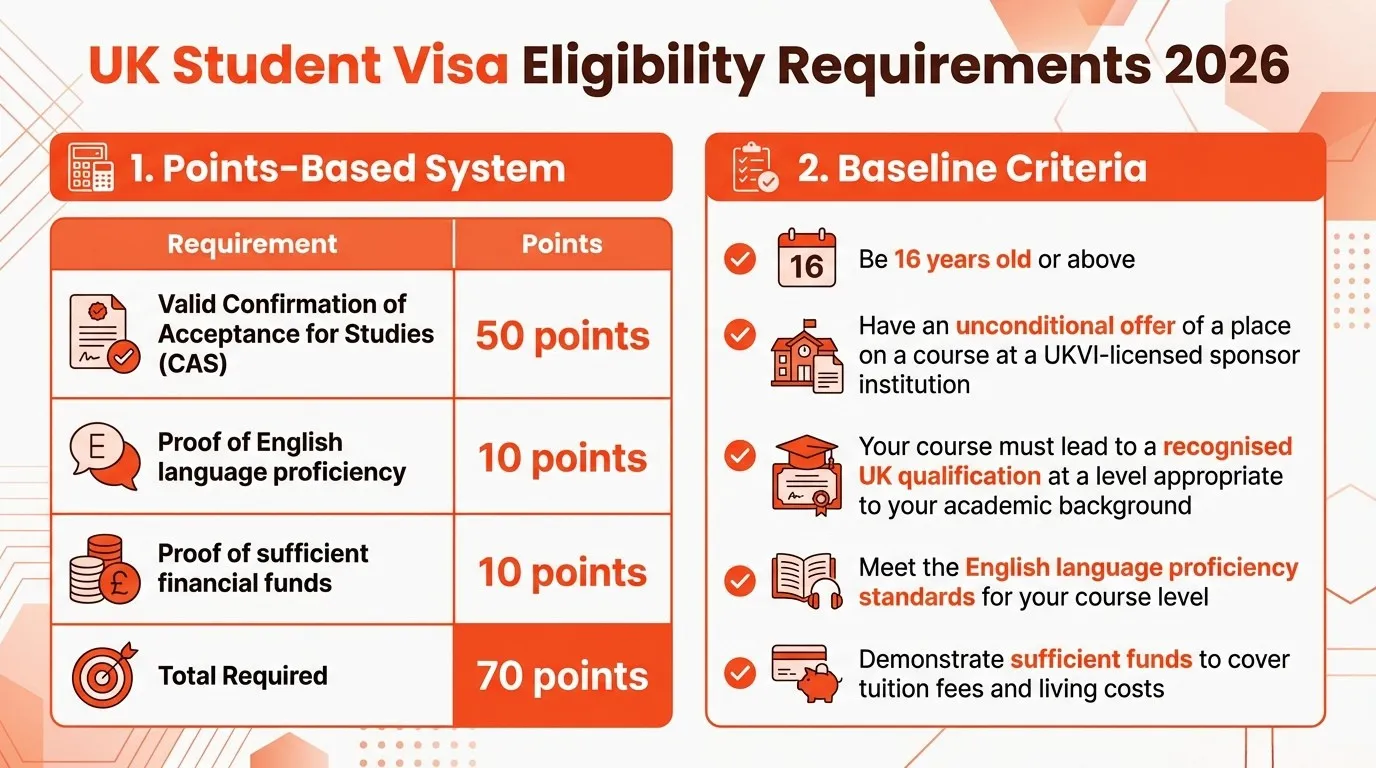
To qualify for the UK Student Visa, you must score a minimum of 70 points under the UK’s Points-Based Immigration System. Points are awarded as follows:
| Requirement | Points |
|---|---|
| Valid Confirmation of Acceptance for Studies (CAS) | 50 |
| Proof of English language proficiency | 10 |
| Proof of sufficient financial funds | 10 |
| Total Required | 70 |
You must also meet these baseline criteria:
- Be 16 years old or above
- Have an unconditional offer of a place on a course at a UKVI-licensed sponsor institution
- Your course must lead to a recognised UK qualification at a level appropriate to your academic background
- Meet the English language proficiency standards for your course level
- Demonstrate sufficient funds to cover tuition fees and living costs
Academic Qualifications Required from Bangladesh
UK universities assess your academic background based on your Bangladeshi qualifications. General benchmarks are:
For Undergraduate (Bachelor’s Degree):
- HSC (or equivalent) with a minimum GPA of 3.0 to 3.5 (requirements vary by institution and course)
- O and A Level combinations are also widely accepted
For Postgraduate (Master’s Degree):
- Recognised bachelor’s degree with a minimum CGPA of 2.5 to 3.0 out of 4.0
- Some universities accept lower GPAs for certain programmes
Don’t meet the standard entry requirements? Many UK universities offer Pathway Programmes — including Foundation Year, International Year One, and Pre-Master’s courses — that accept lower GPA thresholds and lead directly into degree programmes. These are an excellent option for Bangladeshi students whose results fall short of direct entry.
Required Documents for UK Student Visa from Bangladesh
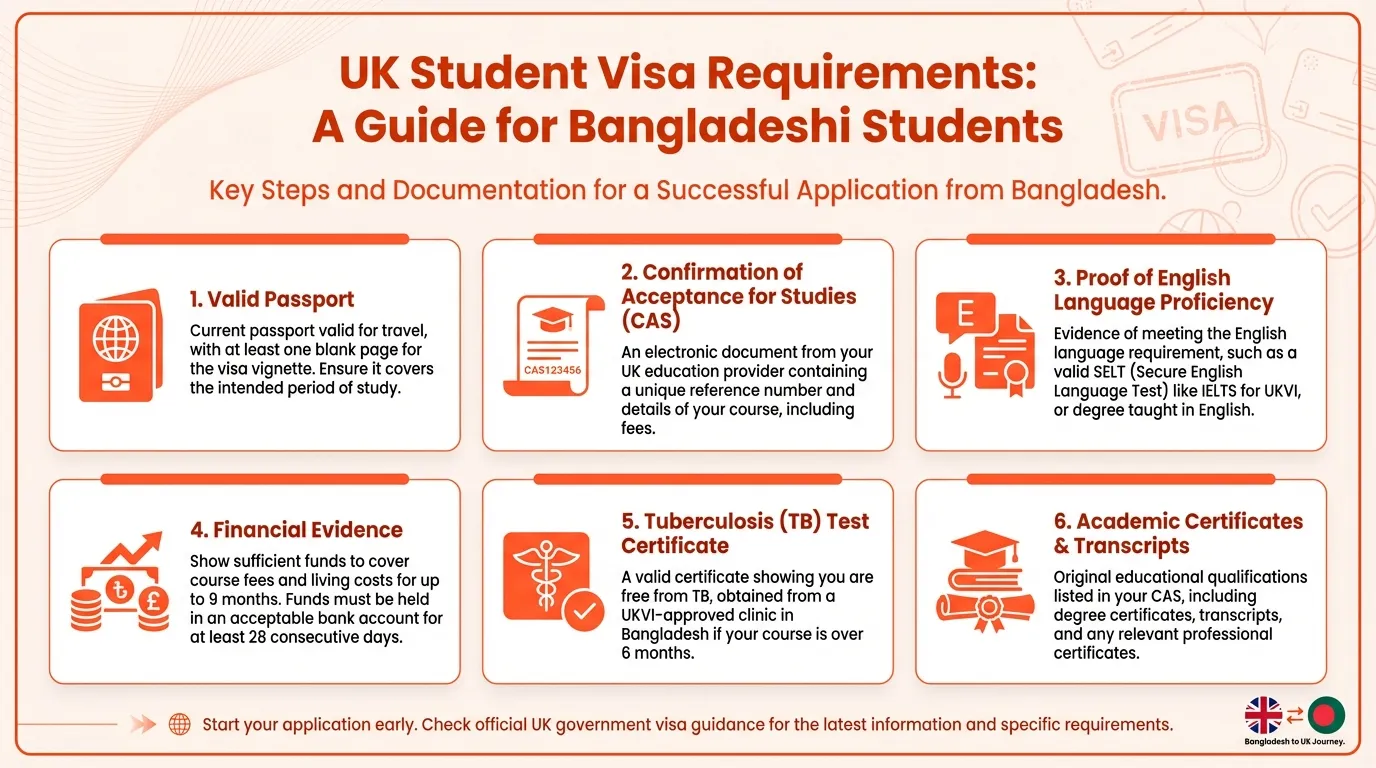
Primary Documents
- Valid passport (minimum 6 months validity beyond your intended stay)
- Confirmation of Acceptance for Studies (CAS) letter from your UK university
- Proof of English language proficiency (IELTS, PTE, TOEFL, or equivalent)
- Financial evidence (bank statements showing required funds held for 28 consecutive days)
- Tuberculosis (TB) test certificate from a UKVI-approved clinic in Bangladesh
- Academic certificates and transcripts (SSC, HSC, bachelor’s degree as applicable)
Additional Supporting Documents
- Passport-sized photographs
- Parental or legal guardian consent letter (for applicants under 18)
- Academic Technology Approval Scheme (ATAS certificate) — required for postgraduate students in certain science, engineering, and technology subjects
- Official scholarship or sponsorship letter (if tuition fees or living costs are covered by a third party)
- Marriage certificate (if bringing a dependant spouse — see Dependant Rules section)
- Birth certificates for any dependent children
Document Translation Requirements
All documents not written in English must be accompanied by a certified English translation. Each translated document must:
- Be dated
- Include the translator’s full name, signature, and contact details
- Confirm it is an accurate translation of the original
The team at MMS Global Services can assist with document preparation and translation guidance for your UK visa application.
Confirmation of Acceptance for Studies (CAS)
The CAS is the most important document in your UK visa application. Without it, you cannot apply.
What is a CAS? A CAS is a unique reference number issued by your UK university after you accept an unconditional offer. It contains your personal details, course information, start and end dates, tuition fee amounts, and your sponsor’s licence number.
How to obtain your CAS:
- Receive and accept an unconditional offer from a UKVI-licensed UK university
- Pay the required tuition deposit (amount specified by your institution)
- Provide your personal and academic details to the admissions office
- The university issues your CAS — this typically takes up to 10 working days
- Apply for your visa within 6 months of receiving the CAS (and no earlier than 6 months before your course start date)
Key details to verify on your CAS:
- Your full name, date of birth, and passport number match your documents exactly
- Course start and end dates are correct
- Tuition fee amount listed is accurate
- The university’s Sponsor Licence Number is valid on the UKVI register of licenced sponsors
Any discrepancy between your CAS and your visa application documents can result in refusal. Double-check every detail before submitting.
English Language Requirements
To demonstrate your English language proficiency for a UK Student Visa, you must typically achieve a minimum CEFR B2 level or higher, depending on your course level.
| Qualification Level | IELTS Academic | PTE Academic | TOEFL iBT |
|---|---|---|---|
| Foundation / Diploma | 5.5 overall | 51 overall | 72 |
| Bachelor’s Degree | 6.0 overall | 54 overall | 72 |
| Master’s Degree | 6.5 overall | 59 overall | 85 |
| PhD / Doctoral | 6.5–7.0 overall | 65 overall | 90+ |
Individual universities may set requirements above these minimums. Always verify the specific score requirements with your institution before applying.
IELTS Waiver: Some universities may waive the IELTS requirement if your previous education was delivered entirely in English and you can provide a Medium of Instruction (MOI) letter. However, a valid IELTS or equivalent score significantly strengthens your visa application — especially for Bangladeshi applicants in the current high-scrutiny environment.
For help preparing for IELTS, visit our IELTS resources section.
Financial Requirements and Proof of Funds
Demonstrating sufficient financial resources is one of the most critical parts of your UK visa application. You must show that you can cover both your tuition fees and your living costs in the UK.
Living Cost Requirements (Maintenance Funds)
| Study Location | Monthly Requirement | 9-Month Total | Approx. in BDT |
|---|---|---|---|
| London | £1,334 | £12,006 | ~৳18.6 Lakhs |
| Outside London | £1,023 | £9,207 | ~৳14.3 Lakhs |
BDT figures approximate based on current exchange rates. Verify the latest rate before applying.
Tuition Fee Evidence
You must also show that you have enough funds to cover your first year’s tuition fees (as stated on your CAS). These vary by institution and course — typically ranging from £10,000 to £30,000 per year for international students.
28-Day Rule — Critical
Your funds must remain in your bank account for 28 consecutive days before the date you submit your visa application. The closing balance on any single day during this period must not fall below the required amount.
Acceptable evidence includes:
- Bank statements (official, dated, showing account holder name and 28-day history)
- Official education loan approval letters
- Government or institutional scholarship confirmation letters
Important: The UKVI does not accept joint bank accounts unless you are under 18. Funds must be held in your own account. The MMS Global team can advise you on structuring your financial evidence correctly — book a free counselling session to get guidance before you apply.
UK Student Visa Fees 2026 (Updated)
Application Fee
| Visa Route | Fee (Before 8 April 2026) | Fee (From 8 April 2026) |
|---|---|---|
| UK Student Visa (main applicant) | £524 | £558 |
| Short-Term Study Visa | £97 (up to 6 months) | Updated rate |
| Switching/extending inside UK | £524 | £558 |
| Graduate Route (post-study work) | £880 | Updated rate |
Immigration Health Surcharge (IHS)
In addition to the visa fee, all student visa applicants must pay the Immigration Health Surcharge (IHS) — this gives you access to NHS healthcare during your studies.
- IHS Rate: £776 per year of your visa (unchanged in April 2026)
- The IHS is calculated on the full visa length, not your course length
- It must be paid upfront in full when you submit your application
| Course Duration | Typical Visa Length | Total IHS (Approx.) | Approx. BDT |
|---|---|---|---|
| 1-year Master’s | ~16 months (2 years IHS) | £1,552 | ~৳2.4 Lakhs |
| 2-year Master’s with placement | ~28 months (3 years IHS) | £2,328 | ~৳3.6 Lakhs |
| 3-year Bachelor’s | ~3.5 years (4 years IHS) | £3,104 | ~৳4.8 Lakhs |
Budget carefully: For most Bangladeshi students, the IHS is the largest single visa cost — often 3–4× the application fee itself.
Approximate Total Upfront Visa Costs in BDT (1-year Master’s example):
| Cost Component | GBP | Approx. BDT |
|---|---|---|
| Visa Application Fee | £558 | ~৳86,000 |
| Immigration Health Surcharge | £1,552 | ~৳2,40,000 |
| TB Test (Bangladesh) | ~£20–£30 | ~৳3,500–5,000 |
| Total (approx.) | ~£2,130 | ~৳3.3 Lakhs |
Excludes tuition fee deposit and proof-of-funds balance.
Tuberculosis (TB) Test Requirements
Bangladesh is on the UK Home Office’s list of countries where a mandatory TB test is required for student visa applicants intending to stay in the UK for more than 6 months.
What you need to do:
- Get tested at a UKVI-approved TB testing clinic in Bangladesh (available in Dhaka, Chittagong, and Sylhet)
- Your test certificate must show a negative TB result
- The certificate is valid for 6 months from the date of issue
- Include the TB certificate with your visa application
Do not book your visa appointment before getting your TB test result, as the certificate is a required document.
ATAS Certificate (Postgraduate Students)
If you are applying for a master’s degree or PhD in certain sensitive subjects — particularly in science, engineering, and technology — you may be required to obtain an Academic Technology Approval Scheme (ATAS) certificate before your university can issue your CAS.
ATAS is a security clearance issued by the UK’s Foreign, Commonwealth & Development Office. Common subjects requiring ATAS include advanced physics, certain engineering disciplines, and nuclear science.
Check whether your course requires ATAS on the official ATAS guidance page. Allow extra time for this — ATAS clearance can take several weeks.
Step-by-Step UK Student Visa Application Process
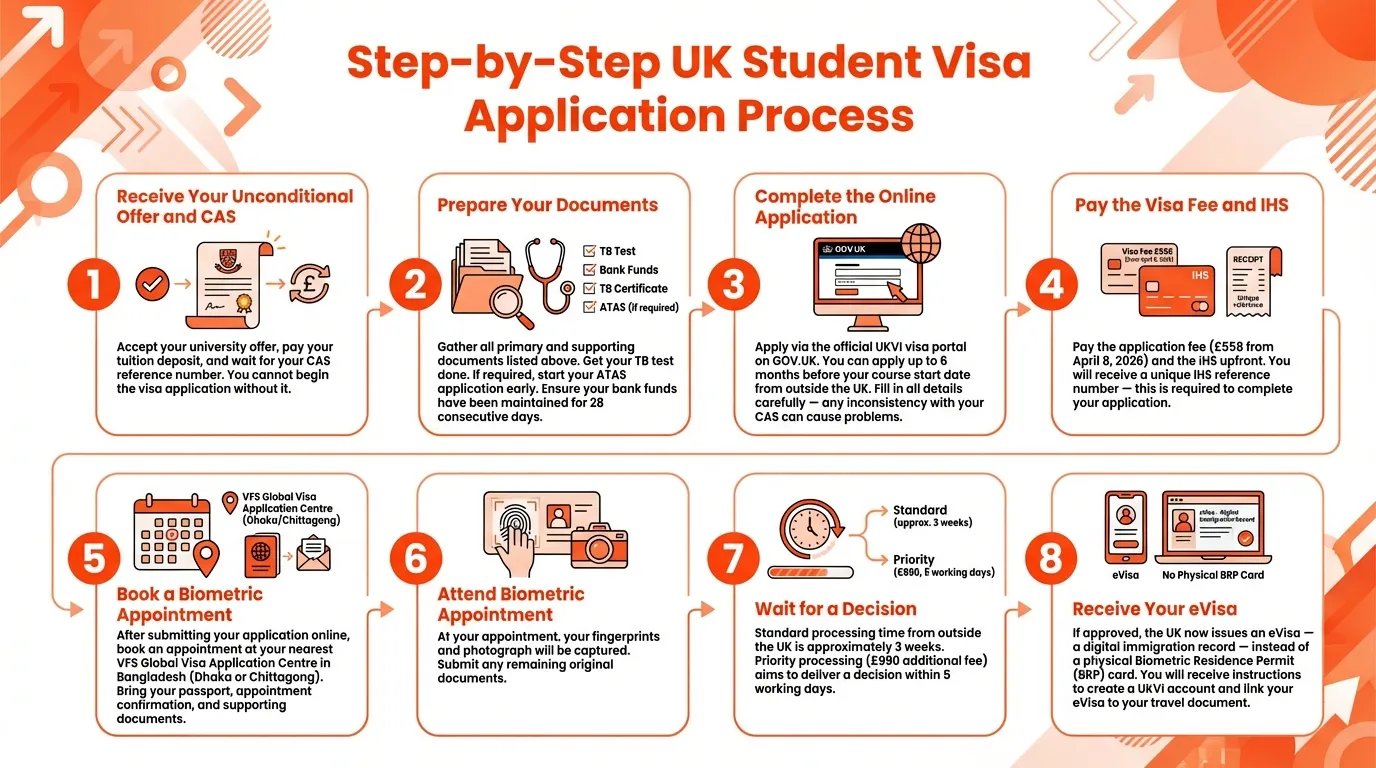
Follow these steps in order to avoid delays or errors.
Step 1: Receive Your Unconditional Offer and CAS Accept your university offer, pay your tuition deposit, and wait for your CAS reference number. You cannot begin the visa application without it.
Step 2: Prepare Your Documents Gather all primary and supporting documents listed above. Get your TB test done. If required, start your ATAS application early. Ensure your bank funds have been maintained for 28 consecutive days.
Step 3: Complete the Online Application Apply via the official UKVI visa portal on GOV.UK. You can apply up to 6 months before your course start date from outside the UK. Fill in all details carefully — any inconsistency with your CAS can cause problems.
Step 4: Pay the Visa Fee and IHS Pay the application fee (£558 from April 8, 2026) and the IHS upfront. You will receive a unique IHS reference number — this is required to complete your application.
Step 5: Book a Biometric Appointment After submitting your application online, book an appointment at your nearest VFS Global Visa Application Centre in Bangladesh (Dhaka or Chittagong). Bring your passport, appointment confirmation, and supporting documents.
Step 6: Attend Biometric Appointment At your appointment, your fingerprints and photograph will be captured. Submit any remaining original documents.
Step 7: Wait for a Decision Standard processing time from outside the UK is approximately 3 weeks. Priority processing (£990 additional fee) aims to deliver a decision within 5 working days.
Step 8: Receive Your eVisa If approved, the UK now issues an eVisa — a digital immigration record — instead of a physical Biometric Residence Permit (BRP) card. You will receive instructions to create a UKVI account and link your eVisa to your travel document.
Work Rights on a UK Student Visa
As a student visa holder, your work rights depend on your course level:
| Study Level | Work Rights During Term | Work Rights During Holidays |
|---|---|---|
| Degree level (Bachelor’s, Master’s, PhD) | Up to 20 hours per week | Full-time |
| Below degree level | Up to 10 hours per week | Full-time |
| Short-term study visa | No work permitted | N/A |
You cannot be self-employed or work as a professional sportsperson on a student visa.
Graduate Route (Post-Study Work Visa) 2026
After successfully completing your studies in the UK, you may be eligible to apply for the Graduate Route visa, which allows you to remain in the UK to work or look for work.
Key details:
- Eligibility: Must have completed a degree-level qualification (bachelor’s, master’s, or PhD) at a UKVI-licensed UK university
- Duration: 18 months for bachelor’s and master’s graduates; 3 years for PhD graduates
- No job offer required — you can work in any occupation at any skill level
- Application fee: £880
2026 Policy Note: The Graduate Route duration for non-PhD graduates was reduced from 2 years to 18 months as part of the UK government’s net migration reduction measures. Plan your post-study pathway accordingly. Completing your degree on time is essential to remain eligible.
Dependant Rules for Bangladeshi Students (Important 2024/2026 Update)
Since January 2024, the UK government significantly restricted the ability of student visa holders to bring family members (dependants) to the UK.
Who CAN bring dependants:
- Students on postgraduate research (PGR) programmes (e.g., PhD, MPhil, or research-based master’s)
- Students on courses funded by government scholarships (e.g., Chevening, Commonwealth)
Who CANNOT bring dependants:
- Students on undergraduate courses
- Students on taught postgraduate programmes (standard Master’s degrees)
If you are planning to bring your spouse or children with you, carefully verify your eligibility before making any commitments.
Important 2026 Policy Updates for Bangladeshi Applicants
The UK Home Office has increased scrutiny on student visa applications from Bangladesh in recent years. Some UK universities have temporarily paused recruitment from Bangladeshi applicants as they adjust to stricter UKVI compliance thresholds imposed on sponsoring institutions. This does not mean you cannot get a UK student visa — but it means your application must be exceptionally well-prepared.
Key factors currently under heightened scrutiny:
- Genuine Student intention: Your personal statement and supporting documents must convincingly demonstrate that your primary purpose is to study, not to use the student visa as a migration route
- Financial credibility: Funds must be clearly traceable and explainable — the UKVI may question funds that appear as sudden lump-sum deposits
- Academic progression: Your chosen course must represent a logical academic step from your previous qualifications
- University selection: Applying to a university that has not paused Bangladeshi recruitment is essential — your MMS counsellor can advise on current university statuses
Read our detailed guide on UK Student Visa Rejections: Critical Mistakes to Avoid to protect your application.
Frequently Asked Questions (FAQ)
Conclusion
Getting a UK Student Visa from Bangladesh in 2026 requires careful planning, precise documentation, and a thorough understanding of the latest UKVI requirements. From securing your CAS and preparing the correct financial evidence, to budgeting for the updated visa fee and IHS, every detail matters.
Key points to remember:
- Visa fee is £558 from 8 April 2026 (plus £776/year IHS — pay upfront)
- You need 70 points under the Points-Based System
- Maintain your required funds for 28 consecutive days before applying
- TB test is mandatory for Bangladeshi applicants
- Dependant rules have changed — only PGR/scholarship students can bring family
- The Graduate Route now offers 18 months post-study in the UK