
Important Update (April 2026): Applications for the Australia Awards Scholarship (AAS) 2027 intake are currently open. The deadline is April 30, 2026 at 2:00 PM AEST. If you are a Bangladeshi student planning to study in Australia, do not miss this window.
As a registered education consultancy helping Bangladeshi students reach Australia since our founding, we at MMS Global have compiled the most up-to-date and Bangladesh-specific guide on fully funded scholarships in Australia for 2026. Whether you are a fresh graduate, a government professional, or an NGO worker — there is a scholarship pathway designed for your profile.
What Is a Fully Funded Scholarship in Australia?
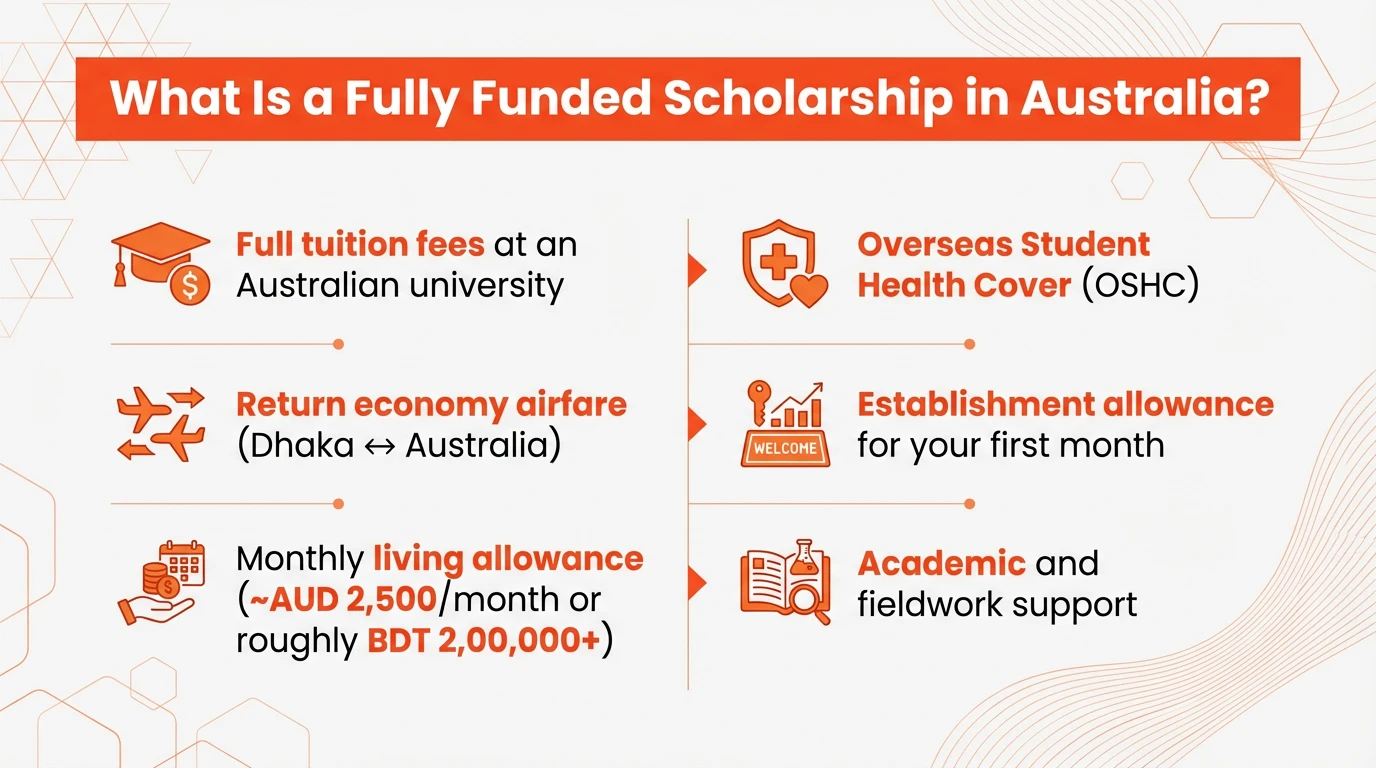
A fully funded scholarship in Australia covers your complete cost of studying, so you can focus entirely on your education and future. For Bangladeshi students, this typically means:
- Full tuition fees at an Australian university
- Return economy airfare (Dhaka ↔ Australia)
- Monthly living allowance (~AUD 2,500/month or roughly BDT 2,00,000+)
- Overseas Student Health Cover (OSHC)
- Establishment allowance for your first month
- Academic and fieldwork support
Unlike partial scholarships, a fully funded scholarship removes financial barriers entirely. For a Bangladeshi student whose family may not have AUD 40,000–60,000 saved for a master’s degree, this is life-changing.
Top Fully Funded Scholarships in Australia for Bangladeshi Students (2026)
Below is a breakdown of the most competitive and accessible fully funded scholarships available to Bangladeshi students right now.
1. Australia Awards Scholarship (AAS): 2027 Intake Now Open
The Australia Awards Scholarship is the flagship fully funded scholarship offered by the Australian Government through the Department of Foreign Affairs and Trade (DFAT). For Bangladeshi students, this is the single most prestigious and comprehensive scholarship available.
Key Dates for Bangladesh:
| Stage | Date |
|---|---|
| Applications Open | February 1, 2026 |
| Applications Close | April 30, 2026 (2:00 PM AEST) |
| Shortlisting Notification | August–September 2026 |
| Interviews | October–November 2026 |
| Scholarship Commencement | February 2027 |
What Does the AAS Cover for Bangladeshi Students?
| Benefit | Details |
|---|---|
| Tuition Fees | 100% covered |
| Return Airfare | Dhaka ↔ Australia (economy class) |
| Living Allowance | ~AUD 30,000/year (≈ BDT 25 lakh+) |
| OSHC (Health Insurance) | Fully covered for duration of studies |
| Establishment Allowance | One-time payment for initial setup |
| Fieldwork Allowance | For eligible research students |
| Pre-course English | Covered if required |
Bangladesh-Specific Eligibility Groups:
The AAS has a unique structure for Bangladeshi applicants. You must fall into one of four priority groups:
- Group A: Civil Service Cadre officials, Bangladesh Bank officials, Judicial Services cadre officers
- Group B: Workers from NGOs, civil society organizations, and development organisations
- Group C: Employees or entrepreneurs from private sector organizations
- Group D: Academics, researchers, media professionals, and cultural organization members
English Language Requirements (Valid by January 1, 2027):
- IELTS Academic: Overall 6.5 (no band below 6.0)
- TOEFL iBT: 84 overall (minimum 21 in all sub-tests)
- PTE Academic: 58 overall (no skill below 50)
Women, people with disability, and those from ethnic minorities may apply with IELTS 6.0 (no band below 5.5). You must then meet the individual university’s requirements upon selection.
How to Apply (OASIS System):
- Visit the official Australia Awards Bangladesh page
- Register on the OASIS (Online Australia Awards Scholarships Information System)
- Complete all sections and upload supporting documents as PDFs by category
- Use your full passport name — no nicknames or abbreviated versions accepted
- Submit before April 30, 2026
Anti-Scam Warning: Australia Awards never charges fees at any stage. Apply only via OASIS. If anyone asks for money for an AAS application, it is a scam.
2. Australian Government Research Training Program (RTP)
The Research Training Program (RTP) is funded by the Australian Government and administered directly by Australian universities. It is the primary fully funded pathway for students pursuing a Master of Research or PhD in Australia.
What RTP Covers:
| Benefit | Amount |
|---|---|
| Full Tuition Fees | 100% waiver |
| Annual Living Stipend | ~AUD 29,000–32,000 (≈ BDT 24–26 lakh) |
| Health Insurance (OSHC) | Covered |
| Research Travel Allowance | Available for eligible students |
Duration:
- PhD: Up to 3 years (with potential 6-month extension)
- Master of Research: Up to 2 years
Who Should Apply: Bangladeshi students with a strong first-class bachelor’s or master’s degree and a research proposal should target RTP. Students from STEM, Public Health, Environmental Science, and Development Studies fields are especially competitive.
How to Apply: Applications are submitted directly through your chosen Australian university’s postgraduate research portal, not through a central system. Each university has its own deadlines — most fall between July–October for February intake and January–April for July intake.
3. Destination Australia Program
The Destination Australia Program incentivises international students — including Bangladeshi students — to study in regional areas of Australia by providing a generous annual scholarship.
Key Facts:
- Value: Up to AUD 15,000 per year (≈ BDT 12.5 lakh)
- Duration: Up to 4 years
- Additional Support: AUD 1,500/year for promotion and administration
- Target: Students willing to study outside Sydney, Melbourne, Brisbane, and Perth
Why Consider Regional Australia? Regional study zones often have lower living costs, better community integration, and strong post-study work visa opportunities. Cities like Geelong, Ballarat, Toowoomba, and Darwin offer high quality of life at a significantly lower cost than capital cities.
4. University-Specific Fully Funded Scholarships
Beyond government programs, Australia’s top universities offer their own fully funded scholarships for international students. Here are the top options Bangladeshi students should target:
| University | Scholarship Name | Coverage | Basis |
|---|---|---|---|
| University of Melbourne | Melbourne Research Scholarship | Full tuition + AUD 32,000 stipend | Research merit |
| University of Sydney | Sydney International Stipend Scholarship | Full tuition + stipend | Research merit |
| Australian National University | ANU Chancellor’s International Scholarship | Up to 100% tuition | Academic excellence |
| Monash University | Monash International Leadership Scholarship | 100% tuition | Academic + leadership |
| Deakin University | Deakin Vice-Chancellor’s International Scholarship | Up to 100% tuition | 85%+ academic average |
| UNSW Sydney | UNSW International Scientia Scholarship | Full tuition + AUD 10,000/year stipend | Research excellence |
| La Trobe University | Vice-Chancellor’s Scholarship | 100% tuition | Academic merit |
| UTS Sydney | UTS Excellence International Scholarship | Up to 50% tuition | 85%+ average |
For Bangladeshi applicants: Monash and Deakin are particularly accessible. Deakin’s scholarship is available to students with an 85% average from their previous qualification — well within reach for strong HSC and honours graduates from Bangladesh.
What Does Studying in Australia Actually Cost? (2026 Guide for Bangladeshi Students)
Understanding the real cost helps you see exactly what a fully funded scholarship saves you.
Tuition Fees (Without Scholarship)
| Level of Study | Annual Cost (AUD) | Annual Cost (BDT approx.) |
|---|---|---|
| Diploma | AUD 15,000–25,000 | BDT 12–21 lakh |
| Bachelor’s | AUD 20,000–45,000 | BDT 17–37 lakh |
| Master’s (Coursework) | AUD 22,000–50,000 | BDT 18–41 lakh |
| PhD (with scholarship) | Usually fully funded | — |
Monthly Living Costs in Australia (2026)
| Expense | Monthly (AUD) | Monthly (BDT approx.) |
|---|---|---|
| Accommodation (shared) | AUD 600–1,200 | BDT 50,000–1,00,000 |
| Food & groceries | AUD 300–500 | BDT 25,000–42,000 |
| Public transport | AUD 120–180 | BDT 10,000–15,000 |
| Internet & utilities | AUD 100–200 | BDT 8,000–17,000 |
| Miscellaneous | AUD 150–250 | BDT 12,500–21,000 |
| Monthly Total | AUD 1,300–2,200 | BDT 1,08,000–1,83,000 |
Note: BDT conversions based on approximate 1 AUD = BDT 83–85 (April 2026).
A fully funded scholarship like the AAS or RTP covers all of the above — meaning you can live in Australia without spending from your family savings.
2026 Alert: Bangladesh Is Now Evidence Level 3 — What This Means for Your Application
As of January 8, 2026, the Australian Department of Home Affairs re-classified Bangladesh from Evidence Level 2 to Evidence Level 3 for student visa applications. This is one of the most important updates you need to know before applying.
What Level 3 Means for Bangladeshi Students:
| Factor | Level 2 (Before) | Level 3 (Now) |
|---|---|---|
| Financial Documents | Standard bank statements | 3–6 months verified statements |
| Verification | Spot-check | Manual, deeper verification |
| Processing Time | ~14 days median | 4–8 weeks |
| Document Format | Standard PDFs accepted | Bank-authenticated originals preferred |
| Scrutiny Level | Moderate | High |
Silver Lining for Scholarship Holders: Students with a fully funded scholarship (AAS, RTP) face significantly lower visa documentation burden because their financial support is directly guaranteed by the Australian Government or a university. This is one more reason why securing a full scholarship is strategic, not just financial.
If you are applying for a student visa as a scholarship holder, read our Complete Guide to Australia Student Visa from Bangladesh and OSHC Health Insurance Guide for Australia Student Visa.
Eligibility Requirements: Can Bangladeshi Students Apply?
Absolutely. Bangladeshi students are fully eligible for all the scholarships listed above. Here is a summary of what you need:
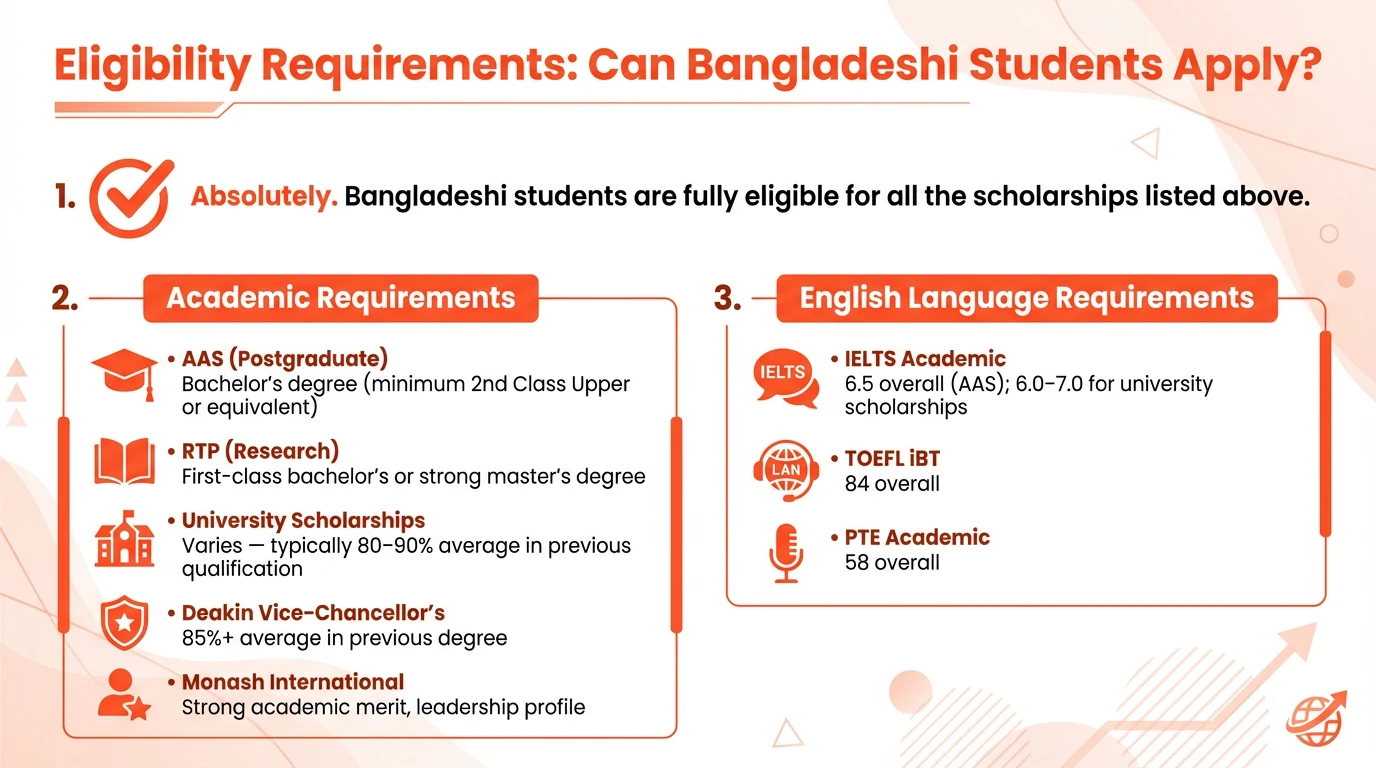
Academic Requirements
| Level of Application | Minimum Qualification |
|---|---|
| AAS (Postgraduate) | Bachelor’s degree (minimum 2nd Class Upper or equivalent) |
| RTP (Research) | First-class bachelor’s or strong master’s degree |
| University Scholarships | Varies — typically 80–90% average in previous qualification |
| Deakin Vice-Chancellor’s | 85%+ average in previous degree |
| Monash International | Strong academic merit, leadership profile |
English Language Requirements
| Test | Minimum Score |
|---|---|
| IELTS Academic | 6.5 overall (AAS); 6.0–7.0 for university scholarships |
| TOEFL iBT | 84 overall |
| PTE Academic | 58 overall |
Need to improve your English test score? Read our guides on IELTS Preparation for Australian University Admission and explore our English proficiency test preparation resources.
Application Timeline: When to Start for 2026–2027
This is the biggest mistake we see Bangladeshi scholarship applicants make — starting too late. Follow this timeline:
| Timeline | Action |
|---|---|
| Now (April 2026) | Final chance to apply for AAS 2027 — deadline April 30 |
| May–July 2026 | Prepare for RTP and university scholarship applications (July 2027 intake) |
| July–September 2026 | Apply to university-specific scholarships for February 2027 intake |
| October–December 2026 | Receive shortlisting/interview invitations for AAS 2027 |
| February 2027 | AAS and major scholarship recipients commence study |
Book a free counselling session with our MMS Global team in Dhaka or Sylhet to map your scholarship strategy today.
Work Rights & Life After Scholarship in Australia
While Studying
International students in Australia can work:
- 48 hours per fortnight during the academic semester
- Unlimited hours during scheduled course breaks (semester breaks, vacations)
- Research students (PhD, Master of Research): unlimited work rights at all times
- Average part-time wage: AUD 22–30 per hour (BDT 1,800–2,500 per hour)
After Graduation: Post-Study Work Visa (PSWV)
Completing a degree in Australia unlocks the Post-Study Work Visa, allowing you to stay and work in Australia after graduation:
| Degree Level | Post-Study Work Visa Duration |
|---|---|
| Bachelor’s (2-year) | 2 years |
| Bachelor’s (3+ year) | 4 years |
| Master’s by Coursework | 3 years |
| Master’s by Research | 3 years |
| PhD | 4 years |
This post-study work pathway also creates a direct route toward Australian Permanent Residency (PR) through skilled migration programs — making a scholarship in Australia not just about education, but about long-term life opportunities.
Explore your study options in Australia with MMS Global to understand which degree level maximizes your PR pathway.
Top Australian Universities for Bangladeshi Scholarship Students
| University | QS Rank 2025 | Location | Strength for BD Students |
|---|---|---|---|
| University of Melbourne | #13 | Melbourne | Research, Medicine, Law |
| University of Sydney | #18 | Sydney | Business, Engineering |
| Australian National University | #30 | Canberra | Public Policy, Research |
| Monash University | #37 | Melbourne | Engineering, Pharmacy |
| University of Queensland | #40 | Brisbane | Environmental Science, Public Health |
| UNSW Sydney | #19 | Sydney | Engineering, IT, Business |
| Deakin University | ~#250 | Geelong/Melbourne | Business, Health — scholarship-accessible |
| La Trobe University | ~#300 | Melbourne | Health, Social Work — scholarship-accessible |
How to Write a Winning Scholarship Application (Bangladesh-Specific Tips)
Based on our experience placing Bangladeshi students into Australian universities, here is what separates successful scholarship applications:
1. Statement of Purpose (SOP) — The Most Critical Document
Your SOP for the AAS must clearly connect your personal background, your professional role in Bangladesh (development, governance, private sector), and how studying in Australia will help you contribute back to Bangladesh’s national development. Generic SOPs fail. Reviewers at DFAT assess your potential for leadership and development impact — not just your academic scores.
2. Document Preparation Checklist
- Academic transcripts (attested/notarized)
- All certificates and degrees (attested)
- IELTS/TOEFL/PTE score report (valid by January 1, 2027 for AAS 2027)
- Passport (valid for at least 2 years beyond scholarship end)
- Employer reference letter on official letterhead
- Academic reference letter from a professor
- Bank statements (3–6 months, verified — Level 3 requirement)
- Updated CV/Resume
3. References: Who to Choose
Do not just choose the most senior person you know. Choose referees who:
- Know your work closely and can provide specific examples
- Can speak to your leadership potential, not just your academic performance
- Will respond promptly if DFAT contacts them for verification
4. Interview Preparation (AAS Shortlisted Candidates)
The AAS interview tests your understanding of:
- Bangladesh’s development priorities
- Why Australia, and why this specific university/course
- How you plan to use your qualifications after returning to Bangladesh
- Your leadership experience and community impact
Our counsellors at MMS Global conduct mock AAS interviews and SOP review sessions. Book your session here.
Additional Financial Support Options
Even if you do not secure a fully funded scholarship on your first attempt, there are supplementary financial support options available:
- Partial Tuition Waivers: Most Australian universities offer 20–50% tuition reduction for high-achieving international students. These can be combined with savings or part-time work income.
- Government of Bangladesh Scholarships: The Bangladesh University Grants Commission (UGC) occasionally offers stipends for students admitted to top overseas universities.
- DFID/World Bank Partnerships: Some development-focused master’s programs in Australia have donor-funded seats for developing country nationals.
- Australian Rotary Health / NGO Grants: For health professionals, educators, and social workers, Rotary and other foundations offer targeted grants.
Study Areas With the Highest Scholarship Availability in Australia (2026)
If you have flexibility in your field of study, these disciplines attract the most scholarship funding for international students — and align with both Australian workforce needs and Bangladesh’s development priorities (important for AAS):
| Field | Scholarship Availability | Bangladesh Development Relevance |
|---|---|---|
| Public Health / Epidemiology | Very High | Healthcare system strengthening |
| Environmental Science / Climate | Very High | Climate adaptation, WASH |
| Engineering (Civil, Environmental) | High | Infrastructure development |
| Information Technology / Data Science | High | Digital economy |
| Education / TESOL | High | Human capital development |
| Governance / Public Policy | High | Civil service reform |
| Agriculture / Food Security | Medium-High | Agricultural development |
How MMS Global Helps You Secure a Scholarship
We are a MARA-affiliated, registered education consultancy with offices in Dhaka and Sylhet, and a dedicated team of counsellors with experience placing Bangladeshi students into Australian universities with scholarship support.
Our scholarship support services include:
- Profile assessment — We identify which scholarships match your academic, professional, and personal profile
- University shortlisting — We shortlist Australian universities based on your scholarship eligibility and career goals
- SOP and essay review — Our writers help craft a compelling, Bangladesh-specific statement of purpose
- Document preparation — We ensure your documents meet Evidence Level 3 requirements (critical for 2026)
- Mock interviews — For AAS and competitive university scholarship interviews
- Visa guidance — Full student visa (Subclass 500) support post-scholarship offer
Frequently Asked Questions (FAQ)
Conclusion: Your Path to a Fully Funded Australian Education Starts Now
Australia remains one of the most generous destinations in the world for international students seeking fully funded scholarships. For Bangladeshi students, the combination of the Australia Awards Scholarship, the Research Training Program, and competitive university scholarships means there are more pathways to a debt-free Australian education than ever before.
The most important thing to understand in 2026 is timing and preparation. The AAS 2027 deadline is April 30, 2026 — just weeks away. If you miss it, the next window opens in February 2027. The Evidence Level 3 reclassification means your documentation must be stronger than ever. And the competition from other South Asian students is fierce.
With expert guidance from MMS Global, the right profile, and a compelling application — the dream of studying in Australia on a full scholarship is absolutely within reach for Bangladeshi students.
Related Articles:
- Australia Student Visa from Bangladesh: Complete Guide 2026
- Health Insurance for Australia Student Visa: Your Complete OSHC Guide 2026
- Study in Australia: Everything Bangladeshi Students Need to Know
External Sources: