
Quick Answer: Neither IELTS nor TOEFL is universally “easier” – it depends on your English style, your destination country, and whether you prefer typing or writing. IELTS is generally better for UK, Australia, Canada immigration, and Europe. TOEFL is preferred for US universities. Read this guide to find out which one is right for you.
IELTS vs TOEFL: The Big Picture
Every year, thousands of Bangladeshi students face the same critical question before applying abroad: IELTS or TOEFL — which one should I take?
It’s not just a matter of which exam is easier. The right test depends on where you’re going, what you’re studying, and how you communicate best in English. Making the wrong choice can cost you time, money (৳20,000–৳25,000 for each exam), and in some cases, your university application.
This guide breaks down everything a Bangladeshi student needs to know – with honest, practical advice that goes far beyond what most comparison articles offer.
What is IELTS?
The International English Language Testing System (IELTS) is jointly owned by the British Council, IDP Education Australia, and Cambridge Assessment English. It has been the world’s most trusted English proficiency test for decades, accepted by over 12,000+ organizations across 140+ countries. In Bangladesh, IELTS is the most commonly taken English proficiency exam — and for good reason.
There are two types of IELTS:
- IELTS Academic — for students applying to undergraduate or postgraduate programs abroad
- IELTS General Training — for immigration, work visa, and some vocational programs
What is TOEFL?
The Test of English as a Foreign Language (TOEFL iBT) is owned by ETS (Educational Testing Service), a US-based organization. TOEFL is entirely computer-based and focuses on American academic English. It is accepted by over 11,500 universities and institutions in more than 150 countries, with a particularly strong presence in the United States and Canada.
Both tests measure the same four skills – Reading, Listening, Writing, and Speaking – but the way they measure those skills is fundamentally different.
Key Differences at a Glance
| Feature | IELTS | TOEFL iBT |
| Owned By | British Council / IDP / Cambridge | ETS (USA) |
| English Style | British / Australian / International | American English |
| Test Duration | ~2 hours 45 minutes | ~2 hours |
| Speaking Format | Face-to-face with a human examiner | Recorded into a microphone |
| Writing Format | Handwritten (paper) or typed (computer) | Typed on computer |
| Question Style | Varied (MCQ, short answer, fill-in-the-blank, essay) | Mostly multiple-choice + integrated tasks |
| Score Scale | Bands 0–9 | Points 0–120 |
| Results Timeline | 3–5 days (computer) / 13 days (paper) | ~6 days |
| One Skill Retake? | ✅ Yes (IELTS One Skill Retake) | ❌ No |
| Immigration Use | ✅ Yes (UK, Canada, Australia) | ❌ Limited |
| Test Fee (Bangladesh) | ~৳20,000–৳23,000 | ~৳22,000–৳25,000 |
| Accepted in UK? | ✅ Yes | ✅ Yes (most universities) |
| Accepted in USA? | ✅ Yes | ✅ Yes (preferred) |
| Accepted in Australia? | ✅ Yes (preferred) | ✅ Yes |
Which is Easier? Section-by-Section Breakdown
Let’s be direct: “Easier” is personal. But here’s an honest breakdown of each section that will help you figure out where you have an advantage.
Reading
IELTS Reading: 60 minutes, 3 passages, 40 questions. Uses a wide variety of question types — true/false/not given, matching headings, sentence completion, and short answer. Passages are drawn from newspapers, books, magazines, and academic journals. The language is relatively accessible.
TOEFL Reading: 35 minutes, 2 passages, 20 multiple-choice questions. Passages are strictly from academic textbooks — dense, technical, and complex. All questions are multiple-choice.
Which is easier? For most Bangladeshi students, IELTS Reading is perceived as easier because the sources feel more familiar (newspapers, general publications), and multiple question types mean you can score well even if you struggle on one type. TOEFL’s academic-only language can be challenging if you’re not used to university-level English texts.
Listening
IELTS Listening: 30 minutes (+10 min transfer for paper). 4 sections, 40 questions. Features a variety of global English accents — British, Australian, American, Canadian. Includes conversations, monologues, and academic lectures.
TOEFL Listening: 36 minutes. Lectures and campus conversations, almost exclusively in American English. Multiple-choice questions only.
Which is easier? If you’ve grown up watching American TV or YouTube, TOEFL Listening may feel easier due to the familiar American accent. However, IELTS’s diverse accents better mirror real-world English. For most Bangladeshi students who studied British-style English in school, IELTS is often more comfortable.
Writing
IELTS Writing: 60 minutes. Two tasks:
- Task 1: Describe a chart, graph, diagram, or map (Academic) OR write a letter (General Training) — ~150 words
- Task 2: Write an argumentative/discursive essay — ~250 words
TOEFL Writing: 29 minutes. Two tasks:
- Integrated Task: Read a passage + listen to a lecture → write a 150–225 word response (typed)
- Independent Task: Write an essay on a given topic (300+ words, typed)
Which is easier? This one is close. IELTS Task 1 (chart description) is unique and needs specific practice. TOEFL’s integrated writing task — where you must synthesize reading and listening — is considered harder by most students. IELTS Writing is generally considered more manageable for Bangladeshi students who are accustomed to essay writing in school. However, if you type faster than you write by hand, the computer-based IELTS or TOEFL could level the playing field.
Speaking
IELTS Speaking: 11–14 minutes, conducted as a live one-on-one interview with a certified human examiner (in-person or via video call). Three parts: introduction/interview, long turn (cue card), and two-way discussion.
TOEFL Speaking: 16 minutes, four tasks. You speak into a microphone, and your recorded answers are scored by multiple human raters plus an AI scoring system. Tasks include independent opinions and integrated responses based on reading and listening.
Which is easier? Most students agree: IELTS Speaking feels more natural. Talking to a real person is conversational, forgiving of minor errors, and allows natural back-and-forth. TOEFL Speaking — speaking into a computer alone in a test room full of other test-takers all talking at once — is widely reported as stressful and unnatural. For introverted students, however, the lack of face-to-face pressure in TOEFL can be a relief.
Overall Difficulty Summary
| Section | Easier for Most BD Students |
| Reading | IELTS |
| Listening | IELTS (British-style learners) / TOEFL (American-style learners) |
| Writing | IELTS |
| Speaking | IELTS |
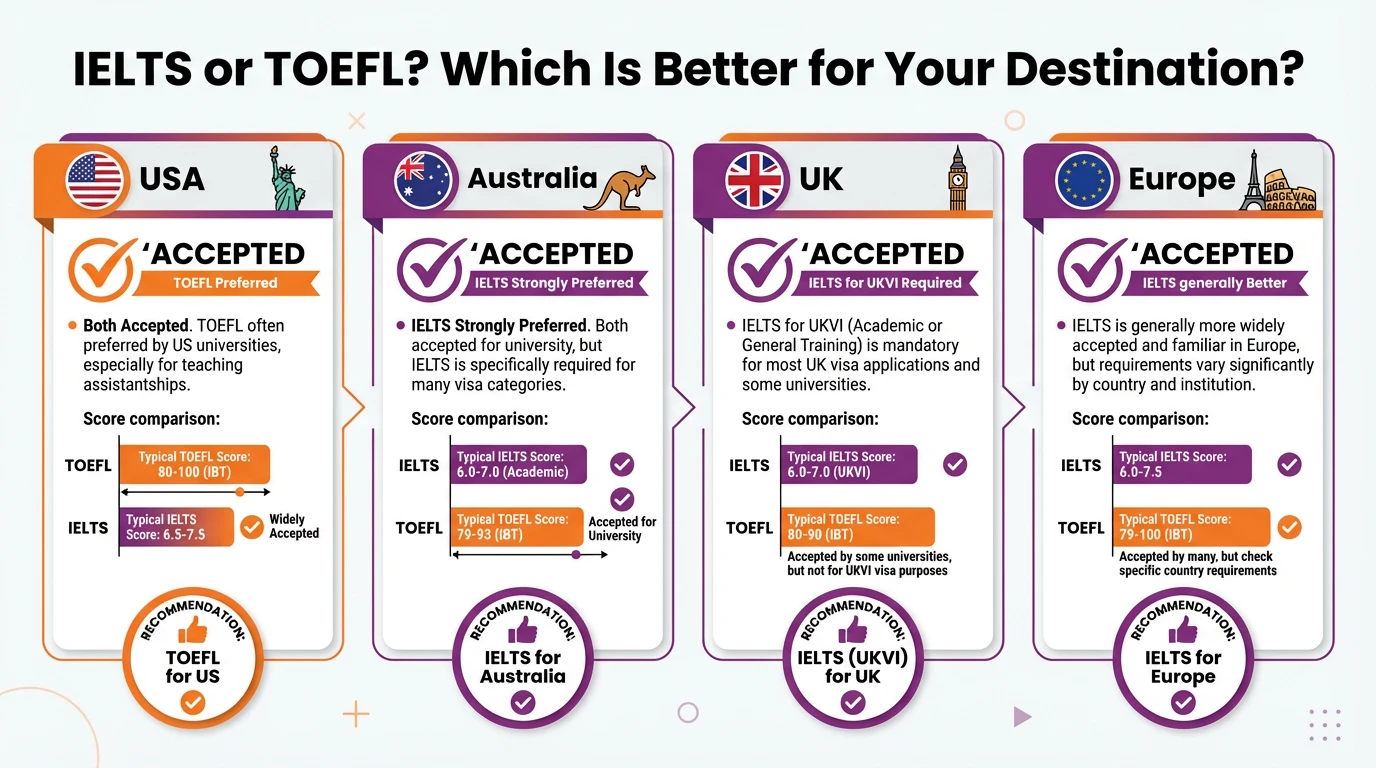
IELTS or TOEFL – Which Is Better for Your Destination?
This is the most important factor. Before deciding which exam to take based on difficulty, always check what your target university or country accepts.
Does the US Accept IELTS or TOEFL?
Short answer: The USA accepts both, but TOEFL is the traditional favorite.
Almost all US universities and colleges accept both IELTS and TOEFL. TOEFL has a stronger historical presence in the US since it was created by an American organization (ETS). Many Ivy League universities – Harvard, MIT, Yale, Columbia – specify score requirements for both but have used TOEFL as their benchmark for decades.
IELTS or TOEFL for Australia?
Short answer: IELTS is strongly preferred for Australia – both for universities and immigration.
Australia’s immigration body, the Department of Home Affairs, accepts several English tests for the Student Visa (Subclass 500), including IELTS, TOEFL iBT, PTE Academic, and Cambridge English.
IELTS Academic is by far the most widely accepted and recognized at Australian universities.
Typical requirements for Australian universities:
- Undergraduate: IELTS 6.0–6.5 (or TOEFL 60–79)
- Postgraduate: IELTS 6.5–7.0 (or TOEFL 79–94)
- Medicine/Law: IELTS 7.0–7.5+
For UK — IELTS or TOEFL?
Short answer: IELTS is the dominant and preferred choice for the UK – for both universities and visas.
The UK Home Office accepts a limited list of Secure English Language Tests (SELTs) for visa applications. IELTS for UKVI (UK Visas and Immigration) is the most widely accepted. TOEFL iBT is accepted by many UK universities for academic admission, but it is NOT accepted for UK visa applications (Student Visa, Skilled Worker Visa, etc.).
This is critical: If you plan to apply for a UK Student Visa, you must take either IELTS for UKVI Academic or another SELT-approved test. A standard TOEFL score cannot be used for UK visa purposes.
Typical IELTS requirements for UK universities:
- Russell Group universities (e.g., Oxford, Cambridge, UCL): IELTS 7.0–7.5 overall
- Standard UK universities: IELTS 6.0–6.5 overall
IELTS or TOEFL for Europe?
Short answer: IELTS is generally better for Europe, though it varies by country and institution.
European countries that conduct programs in English – particularly Germany, Sweden, Denmark, Finland, the Netherlands, and France — accept both IELTS and TOEFL.
IELTS is more universally recognized across European institutions and immigration offices.
- Germany: Both accepted. Many German universities accept IELTS 6.0–7.0 or TOEFL 80–100+.
- Sweden: Both accepted. Most Swedish universities accept IELTS 6.0–6.5 or TOEFL 90+.
- Denmark: Both accepted. IELTS 6.5+ or TOEFL 83+ is typical.
- Finland: Both accepted. IELTS 6.0–6.5 or TOEFL 80–92+ depending on program.
If you’re planning to study in multiple European countries, IELTS offers better flexibility. Some European countries’ immigration departments also require IELTS for residence permit purposes.
Quick Destination Reference Table
| Country/Region | IELTS Accepted? | TOEFL Accepted? | Best Choice |
| USA | ✅ Yes | ✅ Yes (preferred) | Either (TOEFL slight edge) |
| UK | ✅ Yes (+ Visa) | ✅ University only | IELTS |
| Canada | ✅ Yes (+ Immigration) | ✅ Universities only | IELTS |
| Australia | ✅ Yes (+ Immigration) | ✅ Universities only | IELTS |
| Germany | ✅ Yes | ✅ Yes | Either |
| Sweden | ✅ Yes | ✅ Yes | Either |
| Denmark | ✅ Yes | ✅ Yes | Either |
| Finland | ✅ Yes | ✅ Yes | Either |
| New Zealand | ✅ Yes | ✅ Yes | IELTS |
Should I Give IELTS or TOEFL?
Still not sure which test to take? Answer these five questions:
Question 1: Where do you want to study or immigrate?
- UK, Canada, Australia, or New Zealand → Take IELTS
- USA only → TOEFL is traditional, but IELTS works too
- Europe → Either, but IELTS has broader acceptance
Question 2: Do you need the test for immigration (not just study)?
- Yes → IELTS General Training is your only viable option for UK, Canada, and Australia immigration
- No → Either test works
Question 3: How do you prefer to communicate in English?
- I prefer talking to a real person (face-to-face) → IELTS
- I’m comfortable speaking into a microphone or computer → TOEFL
- My English is more British-style (school-trained) → IELTS
- My English is more American-style (US media, YouTube) → TOEFL
Question 4: What’s your strength — writing by hand or typing?
- I write faster by hand → IELTS (paper-based)
- I type faster → TOEFL or computer-based IELTS
Question 5: What’s your test preparation budget and timeline?
- Limited time → TOEFL is shorter (2 hours vs 2 hrs 45 min)
- Need a second chance on one weak section → IELTS (IELTS One Skill Retake available)
- Already preparing with British Council materials → IELTS
If you answered “IELTS” to 3 or more questions → Take IELTS. If you answered “TOEFL” to 3 or more → Take TOEFL.
If you’re still unsure, book a free consultation with an MMS Global advisor who can assess your profile and recommend the right path.
Scholarship Without IELTS or TOEFL — Is It Possible?
Yes – and this is an increasingly important question for Bangladeshi students.
Many students ask: can I get a scholarship without sitting IELTS or TOEFL? The good news is that several universities and scholarship programs do waive English proficiency test requirements under specific conditions.
When Can You Skip IELTS or TOEFL?
Condition 1: Medium of Instruction Waiver If your previous degree or high school education was conducted entirely in English, many universities will waive the IELTS/TOEFL requirement. You’ll typically need an official letter from your institution confirming English as the medium of instruction.
Condition 2: Native or Recognized English-Speaking Country If you’re from a country where English is the official language (e.g., USA, UK, Australia, Canada), most universities automatically waive the requirement. This doesn’t apply to Bangladeshi students unless they have studied in one of these countries.
Condition 3: Alternative English Tests Some universities accept alternative English proficiency proofs beyond IELTS and TOEFL:
- Duolingo English Test (DET): Accepted by 4,000+ universities worldwide, costs only ~৳8,500 BDT, results in 48 hours. Read our full guide to the Duolingo English Test in Bangladesh.
- PTE Academic: Accepted by Australian, UK, and European institutions.
- Cambridge C1 Advanced / C2 Proficiency
- Pearson Test of English
Condition 4: Scholarship-Specific Waivers Some fully-funded and partial scholarship programs for Bangladeshi students may waive IELTS/TOEFL if you meet academic cut-offs or interview requirements:
- Erasmus Mundus (Europe) — Some partner universities accept alternative proofs
- DAAD (Germany) — May accept English medium certificates for non-English programs
- Swedish Institute Scholarships — Some waivers based on medium of instruction
- Some US community colleges — May offer conditional admission with English support
IELTS & TOEFL in Bangladesh: Fees, Test Centres & Dates
IELTS in Bangladesh
Authorized test providers:
- British Council Bangladesh (Dhaka, Chittagong, Sylhet)
- IDP Bangladesh (Dhaka, Chittagong)
IELTS Exam Fee (2026):
- IELTS Academic (Computer-based): ~৳28,450 BDT
- IELTS for UKVI: ~৳27,450 BDT
IELTS Test Frequency: Computer-based tests are available almost every week.
IELTS Score Validity: 2 years from the test date.
Registration: Visit IDP Bangladesh or British Council Bangladesh to register.
TOEFL in Bangladesh
Authorized test provider: ETS authorized test centres in Dhaka (North South University testing centre and other ETS-approved locations)
TOEFL iBT Exam Fee (2026): TOEFL iBT: ~$215 USD (approximately ৳28,000 BDT at current rates)
TOEFL Test Frequency: Available multiple times per month.
TOEFL Score Validity: 2 years from the test date.
Registration: Visit the ETS TOEFL website to register.
Score Comparison: IELTS Band vs TOEFL Points
Universities often list requirements in one format, so knowing how the scores compare is essential.
| IELTS Band Score | TOEFL iBT Score | CEFR Level |
| 9.0 | 119–120 | C2 (Mastery) |
| 8.5 | 115–118 | C2 |
| 8.0 | 110–114 | C2 |
| 7.5 | 102–109 | C1 |
| 7.0 | 94–101 | C1 (Effective) |
| 6.5 | 79–93 | B2+ |
| 6.0 | 60–78 | B2 (Upper Intermediate) |
| 5.5 | 46–59 | B1+ |
| 5.0 | 35–45 | B1 |
Key insight: IELTS goes up to C2 level on the CEFR scale (band 9), while TOEFL iBT maxes out at C1 level even with a perfect score of 120. This means if your target university or immigration program requires C2-level English, only IELTS can certify that level.
Preparation Tips for Bangladeshi Students
For IELTS Preparation
1. Start with the official resources The British Council’s IELTS Ready Premium and Cambridge IELTS Official Practice Materials (Books 1–18) are the gold standard. Use these before any other resource.
2. Focus on band descriptors IELTS uses band descriptors to mark your Writing and Speaking. Download the public band descriptors from the official IELTS website and understand exactly what examiners are looking for at your target band.
3. Practice with diverse accents Since IELTS Listening features British, Australian, and American accents, practice with BBC Podcasts, ABC Australia radio, and TED Talks. Don’t rely only on American YouTube content.
4. Build a writing habit Write Task 1 and Task 2 essays daily. Time yourself. Then compare to model answers from Cambridge books. Common mistake for Bangladeshi students: writing too formally or using memorized templates — examiners are trained to spot these.
5. Use IELTS One Skill Retake strategically If you score well in three sections but poorly in one, you don’t have to retake the full exam. Use this unique IELTS feature to improve your weakest area only.
For TOEFL Preparation
1. Use ETS official materials Start with the Official TOEFL Prep PLUS book and the free TOEFL practice tests on ETS’s website. These are the most accurate representation of the actual test.
2. Practice integrated tasks The integrated writing and speaking tasks (which combine reading + listening + producing) are unique to TOEFL. Most Bangladeshi students underperform here. Practice with lecture videos on Coursera or Khan Academy, then write/speak summaries.
3. Type faster Your TOEFL Writing score is entirely typed. If you type below 40 WPM, work on typing speed using free tools like Keybr or TypeRacer for 15 minutes daily.
4. Get used to speaking into a microphone Set up a recording environment at home and practice answering TOEFL Speaking prompts on timer. Replay and critique yourself. The cold, mechanical format is very different from IELTS — practice is the only solution.
5. Master academic vocabulary TOEFL Reading uses dense academic language. Study the Academic Word List (AWL) — 570 academic word families that appear frequently in TOEFL passages.
Final Verdict
Here is the definitive answer for Bangladeshi students in 2026:
Choose IELTS if you:
- Are applying to UK, Australia, Canada, or New Zealand
- Need the test for immigration/visa purposes (not just university admission)
- Prefer conversational, face-to-face speaking tests
- Studied British-style English in school (most Bangladeshi students)
- Want the flexibility of the One Skill Retake
- Are applying to European universities (IELTS has broader acceptance)
- Are applying for scholarships in Europe (Erasmus Mundus, DAAD, etc.)
Choose TOEFL if you:
- Are applying primarily to US universities
- Prefer a fully computer-based, multiple-choice format
- Are more comfortable with American English
- Type faster than you write
- Prefer a shorter overall test duration (2 hours vs 2 hrs 45 min)
The honest truth: For 80–85% of Bangladeshi students, IELTS is the better choice — primarily because it covers more destinations, serves immigration purposes, and aligns better with the British English curriculum taught in Bangladeshi schools. The MMS Global team advises most students toward IELTS Academic or IELTS for UKVI depending on their destination.
That said, if you have a clear preference for a US institution, enjoy structured multiple-choice tests, and are already comfortable with American English, TOEFL is an excellent choice with no disadvantages for your goals.