
Every year, thousands of Bangladeshi students land at Toronto Pearson, Vancouver International, or Montréal-Trudeau airport with one suitcase, big ambitions, and plenty of questions. What is student life in Canada really like? How much will it actually cost? Can you find halal food, celebrate Eid, and still graduate with distinction?
This guide answers all of it — with 2026-accurate figures, city-by-city breakdowns, and Bangladesh-specific advice that generic guides simply do not provide. Whether you are preparing to depart or are already in Canada trying to settle, bookmark this page.
Why Canada Is the #1 Choice for Bangladeshi Students in 2026
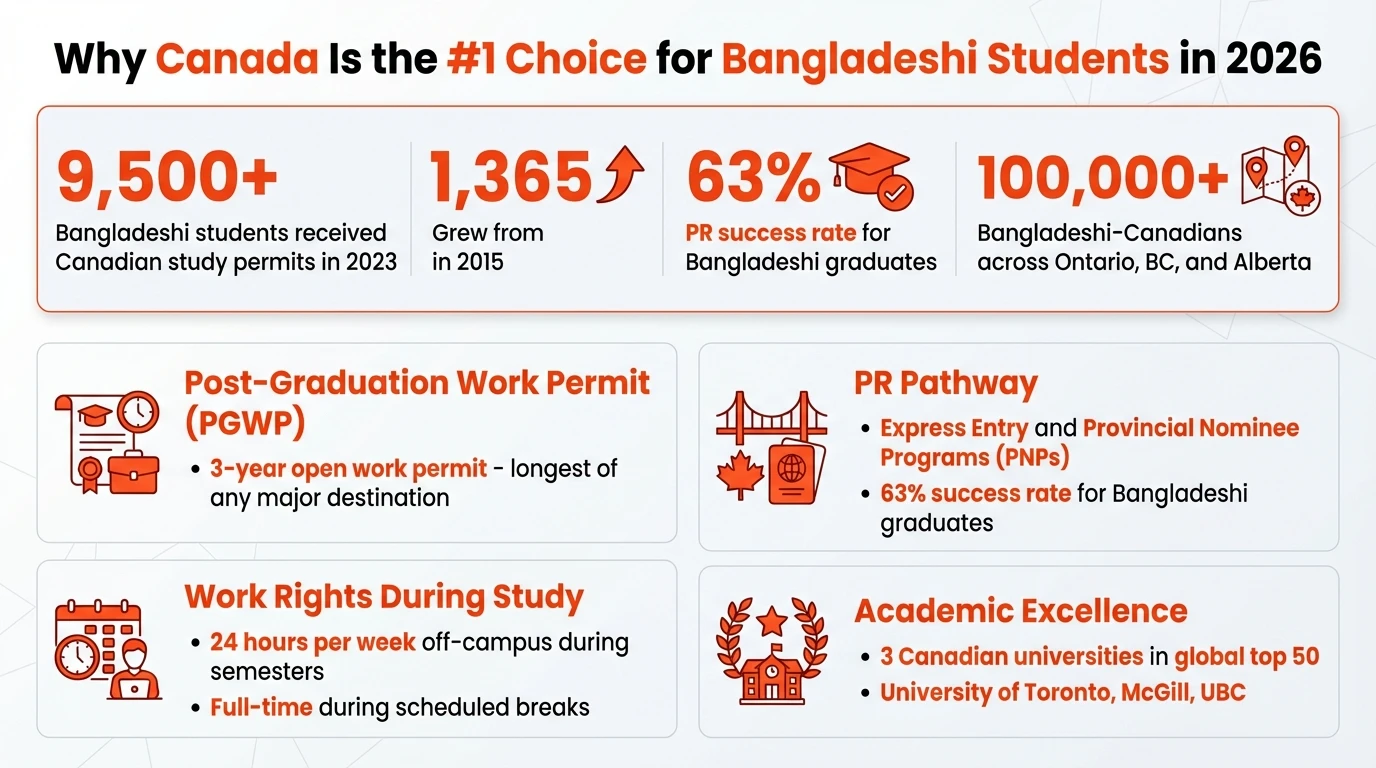
Over 9,500 Bangladeshi students received Canadian study permits in 2023 alone — a number that grew from just 1,365 in 2015, according to IRCC data. Despite tighter permit caps in 2024–2026, Canada remains the top destination because of one powerful combination: globally respected degrees, a clear pathway to Permanent Residency (PR), and a multicultural society where Bangladeshis feel genuinely at home.
Here is what makes Canada stand out for students from Bangladesh:
- Post-Graduation Work Permit (PGWP): Graduate and immediately receive a 3-year open work permit — the longest of any major study destination.
- PR Pathway: Bangladeshi graduates of Canadian institutions achieve a 63% PR success rate through Express Entry and Provincial Nominee Programs (PNPs).
- Work Rights During Study: International students can work up to 24 hours per week off-campus during semesters and full-time during scheduled breaks (2026 IRCC rule).
- Academic Excellence: Three Canadian universities — University of Toronto (UofT), McGill, and UBC — rank in the global top 50 (Times Higher Education 2026).
- Bangladeshi Community: Over 100,000 Bangladeshi-Canadians live across Ontario, BC, and Alberta, forming a strong support network for new students.
Understanding the Cultural Shift: What to Expect
Student life in Canada is built on three cultural values that differ from life in Bangladesh: punctuality, independence, and direct communication. Professors expect students to express opinions in class, challenge readings, and attend office hours. This is not disrespect — it is how Canadian academia works, and mastering it will set you apart.
At the same time, Canada is the world’s most multicultural country. You will find mosques in every major city, halal grocery stores, Bangladeshi restaurants, and communities that celebrate Eid ul-Fitr and Pohela Boishakh with full enthusiasm. The cultural adjustment is real, but you are never truly alone.
Key cultural adjustments Bangladeshi students report:
- Weather: Winters in Toronto and Montreal can drop to -20°C. Invest in a quality winter jacket (CAD 150–300) before your first November.
- Direct communication: Canadians say ‘no’ politely but directly. Adjust to this — it is not rudeness.
- Self-reliance: Cooking, cleaning, and managing finances fall entirely on you. Start learning basic cooking before you leave Dhaka or Sylhet.
- Academic integrity: Plagiarism consequences are severe. Always cite sources and use Turnitin before submitting assignments.
- Time management: Classes, part-time work, and social life compete for the same 24 hours. Build a weekly schedule from day one.
Step-by-Step: Your First 30 Days in Canada
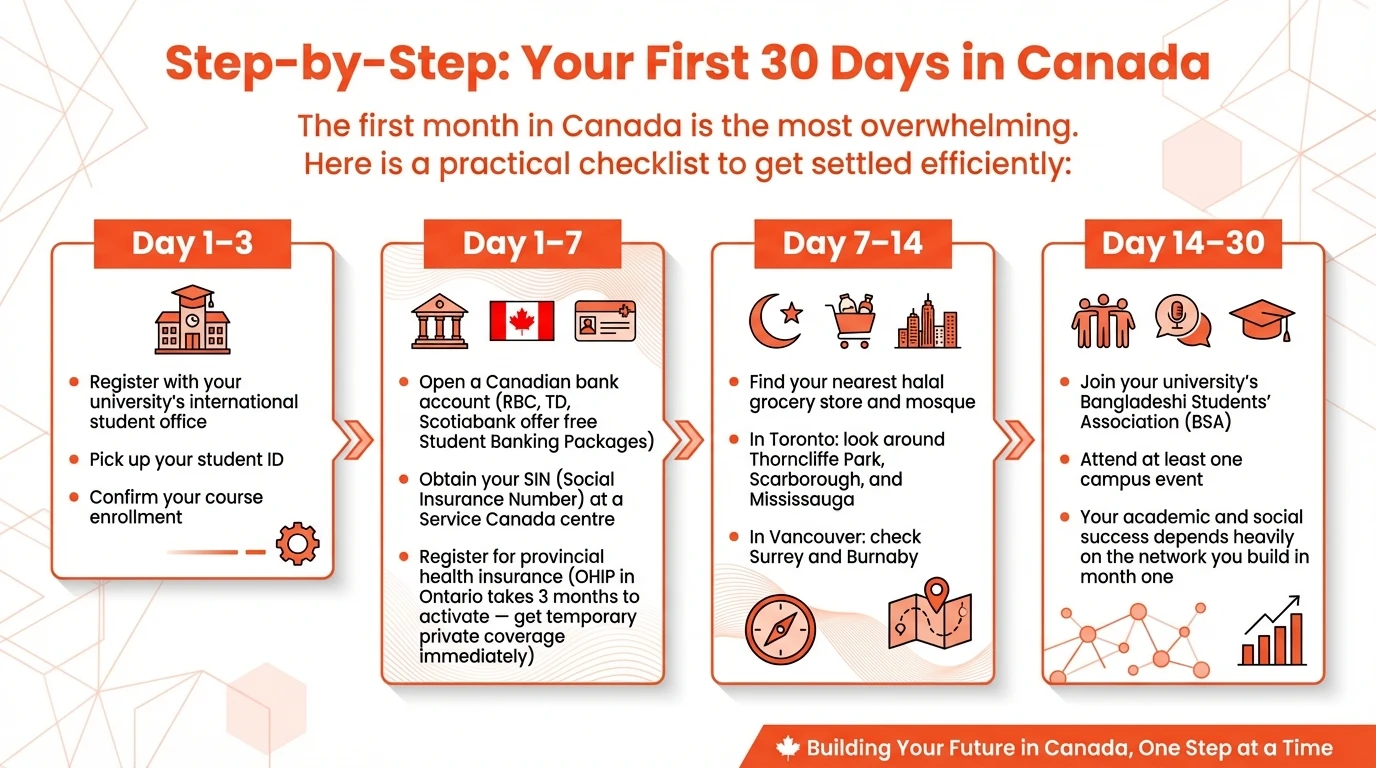
The first month in Canada is the most overwhelming. Here is a practical checklist to get settled efficiently:
- Day 1–3: Register with your university’s international student office. Pick up your student ID. Confirm your course enrollment.
- Day 1–7: Open a Canadian bank account. RBC, TD, and Scotiabank all offer free Student Banking Packages with no monthly fees for international students.
- Day 1–7: Obtain your SIN (Social Insurance Number) at a Service Canada centre — you need this before starting any paid work.
- Day 1–7: Register for provincial health insurance (OHIP in Ontario takes 3 months to activate — get temporary private coverage immediately).
- Day 7–14: Find your nearest halal grocery store and mosque. In Toronto, look around Thorncliffe Park, Scarborough, and Mississauga. In Vancouver, check Surrey and Burnaby.
- Day 14–30: Join your university’s Bangladeshi Students’ Association (BSA). Attend at least one campus event. Your academic and social success depends heavily on the network you build in month one.
Planning your move to Canada? Book a free counselling session with MMS Global’s Canada specialists in Dhaka or Sylhet.
Student Accommodation in Canada: 2026 Complete Guide
Finding the right place to live is the single most important practical decision you will make as an international student in Canada. Costs vary dramatically by city and accommodation type. Here is a complete breakdown:
| Accommodation Type | Monthly Cost (CAD) | Pros | Cons |
|---|---|---|---|
| On-Campus Residence | CAD 800–1,400 | Safe, convenient, social, meal plans available | Limited availability, not always cheaper, shared bathrooms |
| Shared Off-Campus Apartment | CAD 700–1,200/room | Most affordable option, independence, flexible | Need to sign a 12-month lease, manage utilities yourself |
| Private Apartment | CAD 1,500–2,800 | Full privacy, own kitchen, more space | Expensive, especially in Toronto and Vancouver |
| Homestay | CAD 1,000–1,600 (meals included) | Immersive, utilities/meals included, supportive hosts | Less freedom, curfews possible, variable host quality |
| Student Residence (Private) | CAD 900–1,500 (utilities included) | All-inclusive, student community, furnished rooms | More expensive per sq. ft., limited cooking |
Recommendation for Bangladeshi students: Start with on-campus housing for your first semester to build your network and understand the city. Then transition to a shared apartment with 2–3 Bangladeshi or South Asian classmates for year 2. This typically cuts your housing cost by 30–40%.
Cost of Living in Canada for Students: 2026 City-by-City Breakdown
The monthly cost of student life in Canada ranges from CAD 1,500 to CAD 2,500 depending on your city and lifestyle. Here is a realistic breakdown across the most popular cities for Bangladeshi students:
| Monthly Expense | Toronto | Montreal | Calgary | Winnipeg |
|---|---|---|---|---|
| Shared Housing | CAD 900–1,200 | CAD 650–900 | CAD 750–1,000 | CAD 550–800 |
| Groceries | CAD 280–380 | CAD 250–330 | CAD 260–350 | CAD 230–310 |
| Transit (Student Pass) | CAD 128 | CAD 57 (OPUS) | CAD 112 | CAD 98 |
| Utilities (if shared) | CAD 50–80 | CAD 50–80 | CAD 60–90 | CAD 55–85 |
| Mobile Plan | CAD 35–50 | CAD 30–45 | CAD 35–50 | CAD 30–45 |
| Health Insurance | CAD 50–80/mo | Provincial (free) | Provincial (free) | CAD 45–70/mo |
| Personal & Leisure | CAD 200–300 | CAD 150–250 | CAD 180–260 | CAD 150–220 |
| TOTAL (Estimated) | CAD 1,700–2,300 | CAD 1,340–1,900 | CAD 1,450–2,000 | CAD 1,200–1,600 |
Note: These estimates exclude tuition fees and are based on shared accommodation. Proof of Funds requirement for a 2026 Canadian Student Visa: CAD 22,895/year (outside Quebec) and CAD 24,617/year (Quebec), as per IRCC. These are IRCC minimums — budget 15% above this for comfort.
Part-Time Work in Canada: What Bangladeshi Students Need to Know in 2026
One of the biggest advantages of studying in Canada is the ability to work while studying. Here is the 2026 update that many guides still get wrong:
2026 Work Rule Update: International students with a valid study permit can now work up to 24 hours per week off-campus during academic sessions (updated from the previous 20-hour limit). During scheduled breaks (summer, winter holidays), there is no hour restriction — you can work full-time.
Hourly wages in Canada range from CAD 15.65 (Ontario minimum wage, 2026) to CAD 22+ per hour for skilled roles. Common jobs for Bangladeshi students include:
- Retail and food service (Tim Hortons, Walmart, Sobeys): CAD 15–18/hr — easy to find, flexible shifts
- Campus roles (TA, library assistant, IT help desk): CAD 16–22/hr — best for academics, convenient
- Tutoring (math, science, Bengali language): CAD 20–35/hr — high flexibility, strong earnings
- Delivery and rideshare (DoorDash, Uber Eats): CAD 15–25/hr — works around class schedules
- Freelance (writing, design, software): CAD 20–50/hr — perfect if you have marketable skills
Important: Apply for your Social Insurance Number (SIN) at Service Canada on your first week. You cannot legally work without it. File a Canadian tax return each spring — most students receive a refund.
Transportation: Getting Around Canadian Cities as a Student
| City | Transit System | Student Cost (2026) | Notes |
|---|---|---|---|
| Toronto | TTC (buses, subway, streetcar) | CAD 128/mo | Post-Secondary pass available. Presto card required. Regular monthly pass: CAD 156. |
| Montreal | STM Metro & buses | CAD 57/mo (OPUS) | Best public transit deal in Canada. Student OPUS card gives 40% off. Extensive bike-share (BIXI) network. |
| Vancouver | TransLink (SkyTrain, bus, SeaBus) | CAD 112/mo | Compass card system. U-Pass program at UBC and SFU includes transit in student fees. |
| Calgary | Calgary Transit | CAD 112/mo | Post-secondary pass. Light Rail Transit (LRT) free in downtown core. Good bus network. |
| Winnipeg | Winnipeg Transit | CAD 98/mo | Most affordable transit of major cities. Convenient for University of Manitoba students. |
Pro tip: Many Canadian university campuses have free shuttle services between campuses and residential areas. Check your university’s transportation services page before purchasing a monthly transit pass.
Academic Life in Canada: How to Succeed
Canadian universities are academically rigorous, but the support infrastructure is exceptional. Here is what the academic environment looks like for international students:
- Class sizes: Undergraduate lectures can have 200–500 students, but tutorials and labs are 15–30 students. Attend both.
- Academic advising: Every student has access to a faculty advisor. Meet yours in week one and revisit every semester to confirm your course plan.
- Writing centres: All major universities have free writing centres — use them, especially for your first papers. Canadian academic writing style differs significantly from Bangladeshi academic writing.
- Library resources: UofT, UBC, and McGill libraries offer free access to thousands of journals, JSTOR, and research databases. Use these instead of paying for papers.
- Grading culture: Grades in Canada reflect actual performance, not effort or attendance alone. A ‘B’ (70–79%) is considered good. An ‘A’ (80%+) is excellent.
- Academic integrity: Turnitin, AI detection tools, and exam invigilation are standard. Never submit work that is not your own.
The Bangladeshi Community in Canada: Your Home Away From Home
One of the most underrated aspects of student life in Canada for Bangladeshi students is the vibrant Bangladeshi-Canadian community. With over 100,000 Bangladeshi-Canadians concentrated in Greater Toronto, Metro Vancouver, and Edmonton, you will never be far from familiar culture, language, and food.
Bangladeshi Student Associations by University
- University of Toronto: Bangladeshi Students’ Association (BSA at UofT) — organises Pohela Boishakh, Eid gatherings, career networking
- McGill University: Bangladeshi Students’ Union — mentorship for new students, academic support, cultural events
- UBC Vancouver: BSA at UBC — strong advocacy, vibrant social calendar, annual Bangla Night
- York University: Bengali Students’ Association — large Bengali-speaking community, annual cultural show
- Ryerson (Toronto Metropolitan) University: Active South Asian student network with strong Bangladeshi presence
Halal Food & Mosques
Finding halal food in Canada is easier than most Bangladeshi students expect. Here are resources by city:
- Toronto: Largest halal food scene in Canada. Areas like Scarborough, Thorncliffe Park, and Mississauga have full Bangladeshi restaurants, halal butchers, and grocery stores.
- Montreal: Halal options available in Parc-Extension and NDG neighbourhoods. Several mosques including the Islamic Cultural Centre.
- Vancouver: Surrey and Burnaby have excellent halal grocery options. Several mosques across Metro Vancouver.
- Calgary: Marlborough area has halal grocers. Al-Madinah Islamic Centre hosts a large Muslim student community.
- Apps to use: Zabihah.com and HalalTrip for finding halal restaurants anywhere in Canada.
Cultural Events to Look Forward To
- Eid ul-Fitr & Eid ul-Adha: Large community prayers are held in convention centres and mosques across all major cities. Students organise Eid dinners and gatherings.
- Pohela Boishakh (Bengali New Year): Celebrated in April — look for events at your university’s cultural centre or local Bangladeshi community association.
- Bangladesh Independence Day (March 26): BSA chapters organise commemorations and cultural programmes.
- Victory Day (December 16): Community gatherings, cultural shows, and food events across Canada.
Health, Mental Well-being & Healthcare in Canada
Healthcare in Canada is provincially managed, and as an international student, your coverage depends on your province and university:
- Ontario (OHIP): Covers international students, but there is a 3-month waiting period. Get temporary private insurance on arrival — your university’s international student office will have options.
- British Columbia (HIBC): Many universities include the BC Medical Services Plan. Check with your institution.
- Quebec: International students are NOT covered by RAMQ (provincial health). You must enrol in your university’s group insurance plan — typically CAD 600–900/year.
- Alberta and Manitoba: Provincial health plans cover international students immediately upon arrival in most cases.
Mental health is one of the most underreported challenges of student life in Canada. Homesickness, academic pressure, financial stress, and cultural isolation are all real. Every Canadian university offers free counselling services — use them without hesitation. There is absolutely no stigma in seeking help.
Practical health tips for Bangladeshi students in Canada:
- Dress appropriately for winter — hypothermia is a real risk if you underestimate Canadian winters.
- Get a flu shot every autumn — available free at most university health centres.
- Maintain your Bangladesh health records and bring vaccination certificates.
- Exercise regularly. Canadian campuses have excellent, often free, gym facilities included in your student fees.
After Graduation: PGWP, Jobs & the Path to PR
Understanding what comes after your degree is essential before you start your studies. This is where Canada genuinely outshines every other study destination for Bangladeshi students.
Post-Graduation Work Permit (PGWP): Upon completing a degree or diploma at a Designated Learning Institution (DLI), you can apply for a PGWP. For programmes of 2 years or longer, you receive a 3-year PGWP. For programmes shorter than 2 years but longer than 8 months, the PGWP matches your programme length.
Permanent Residency Pathways: After 1 year of skilled work experience in Canada on a PGWP, you qualify for Canadian Experience Class (CEC) under Express Entry. Bangladeshi graduates also qualify for various Provincial Nominee Programs (PNPs), which add +600 points to your Express Entry score — effectively guaranteeing an Invitation to Apply (ITA) for PR.
Starting salaries for popular programmes:
- Computer Science / Software Engineering: CAD 75,000–95,000/year
- Business / Finance: CAD 55,000–75,000/year
- Engineering (Civil, Electrical, Mechanical): CAD 65,000–85,000/year
- Nursing / Healthcare: CAD 60,000–80,000/year
- Data Science / AI/ML: CAD 80,000–110,000/year
Practical Money Management Tips for Bangladeshi Students
Managing finances efficiently is what separates students who thrive in Canada from those who struggle. Here are proven strategies from students who have done it:
- No Frills, Walmart, FreshCo: Shop at these budget supermarkets. Avoid Loblaws and Metro for groceries — they are 20–30% more expensive.
- Cook in batches: Prepare rice, dal, and curries in bulk on Sundays. This brings food costs down to CAD 200–280/month even in Toronto.
- Student discounts: Use your student ID for movie tickets, Spotify, Adobe, Microsoft Office, transit passes, and retail discounts. The savings are significant.
- Banking: Open an account with RBC, TD, or Scotiabank. Their student accounts have zero monthly fees. Avoid international wire transfer fees by using Wise (formerly TransferWise) for sending/receiving money from Bangladesh.
- Tax refunds: File your taxes every April, even for part-time income. Most international students receive CAD 200–800 back as a tax refund.
- Emergency fund: Maintain a minimum CAD 500 emergency buffer. Canadian winters can mean unexpected costs (broken heating, emergency medical).
Is Canada Still Worth It in 2026? Honest Answer for Bangladeshi Students
Yes — but with clear eyes. Canada has tightened study permit caps in 2024–2026, raising the proof of funds requirement to CAD 22,895 and reducing permit numbers by 35%+. This means the application process is more competitive and the financial bar is higher.
But for students who qualify, Canada remains the superior choice:
- 3-year PGWP vs. Australia’s 2–4 year (variable) and UK’s 2-year Graduate Route
- 63% PR success rate for Bangladeshi graduates vs. significantly lower rates from UK and Australia
- Lower tuition vs. USA and UK (average CAD 30,000–40,000/year vs. USD 45,000–65,000+ in the US)
- Multicultural society where Bangladeshi students genuinely feel at home within weeks
The students who succeed in Canada in 2026 are those who plan meticulously, choose DLI-recognised programs strategically, and work with experienced registered consultancies like MMS Global Services that know the Bangladesh-to-Canada pathway inside out.
Frequently Asked Questions (FAQ)
Start Your Canada Journey with MMS Global
MMS Global Services is a registered education and migration consultancy with offices in Dhaka (Lalmatia) and Sylhet. Our team has helped hundreds of Bangladeshi students navigate the full Canada journey — from choosing the right DLI and programme, to student visa application, accommodation guidance, and post-arrival support.
Whether you are just starting to explore or have already received your acceptance letter, a free counselling session with our Canada specialists will give you a clear, honest roadmap tailored to your specific profile and goals.