
For Bangladeshi students, the US Embassy interview in Dhaka is the final — and most anxious — step on the road to an American university. The window interaction lasts just two to three minutes, but the preparation behind it can take weeks.
And in 2026, the landscape has changed significantly: new policy updates, a stricter DS-160 requirement, mandatory social media screening, and a more scrutinised visa climate mean that students who walk in underprepared are at a real disadvantage.
This guide gives you everything you need — what to bring, what you’ll be asked, how to schedule your appointment, how to handle 2026 policy changes, and exactly what happens after you leave the window.
2026 Policy Alert for Bangladeshi Students: Presidential Proclamation 10998, effective January 1, 2026, restricts entry for nationals of certain countries. Bangladesh is NOT on the full or partial ban list for F-1 student visas. However, immigrant visa issuances for Bangladeshi nationals have been paused since January 21, 2026 — this affects green card processing, not your F-1 student visa application. F-1, M-1, and J-1 student visa interviews continue as normal at the US Embassy in Dhaka. Always verify your status at bd.usembassy.gov before your appointment date.
What Type of Student Visa Do You Need?
Before you book your appointment at the US Embassy in Dhaka, confirm which visa category applies to your programme.
| Visa Type | Who It’s For | Key Document |
|---|---|---|
| F-1 | Full-time academic programmes (undergraduate, master’s, PhD, English language programmes) | Form I-20 |
| M-1 | Vocational or non-academic training programmes | Form I-20 |
| J-1 | Exchange visitors, research scholars, government-sponsored programmes | Form DS-2019 |
The vast majority of Bangladeshi students studying in the USA hold an F-1 visa. This guide focuses primarily on F-1 applicants, though the interview preparation tips apply across all three categories.
Step-by-Step: How to Schedule Your US Embassy Interview in Dhaka
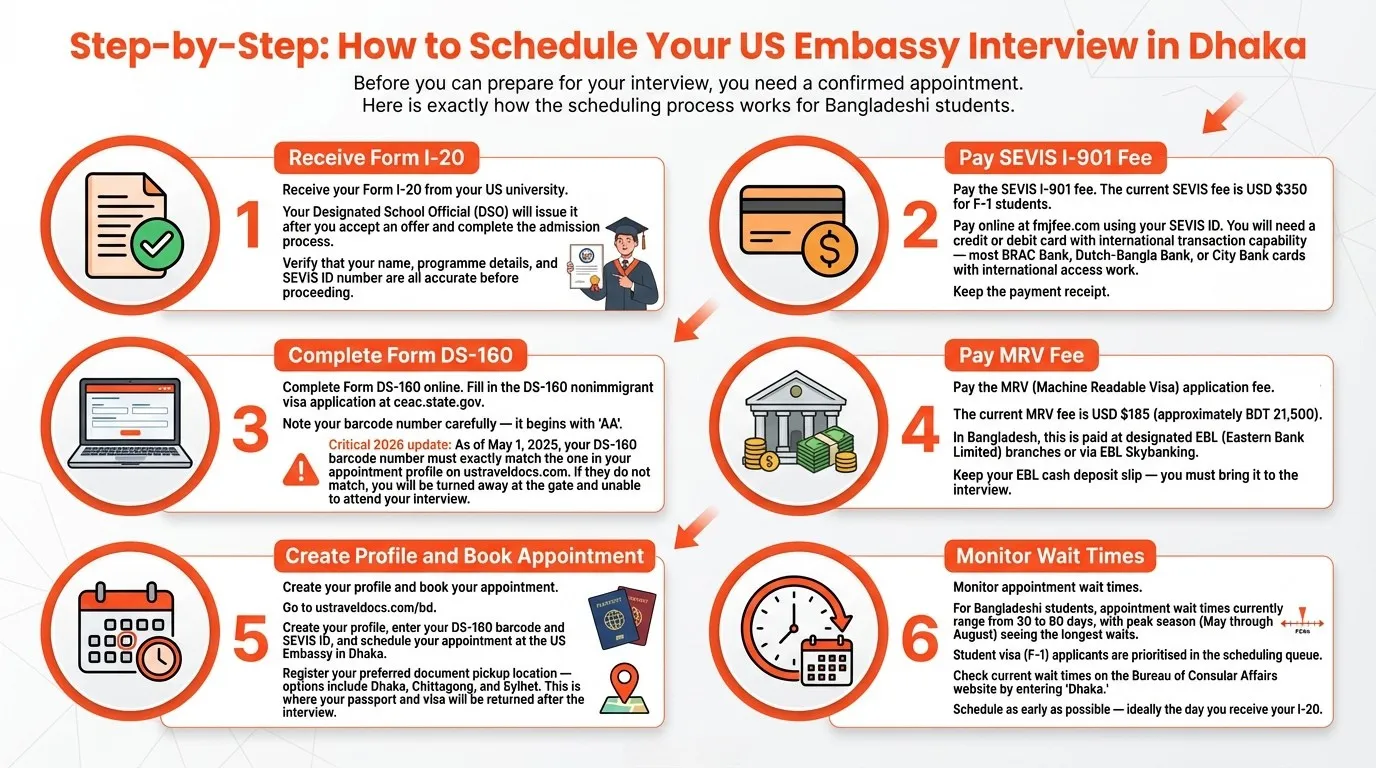
Before you can prepare for your interview, you need a confirmed appointment. Here is exactly how the scheduling process works for Bangladeshi students.
Step 1 — Receive your Form I-20 from your US university. Your Designated School Official (DSO) will issue it after you accept an offer and complete the admission process. Verify that your name, programme details, and SEVIS ID number are all accurate before proceeding.
Step 2 — Pay the SEVIS I-901 fee. The current SEVIS fee is USD $350 for F-1 students. Pay online at fmjfee.com using your SEVIS ID. You will need a credit or debit card with international transaction capability — most BRAC Bank, Dutch-Bangla Bank, or City Bank cards with international access work. Keep the payment receipt.
Step 3 — Complete Form DS-160 online. Fill in the DS-160 nonimmigrant visa application at ceac.state.gov. Note your barcode number carefully — it begins with “AA”. Critical 2026 update: As of May 1, 2025, your DS-160 barcode number must exactly match the one in your appointment profile on ustraveldocs.com. If they do not match, you will be turned away at the gate and unable to attend your interview.
Step 4 — Pay the MRV fee. The current MRV (Machine Readable Visa) application fee is USD $185 (approximately BDT 21,500). In Bangladesh, this is paid at designated EBL (Eastern Bank Limited) branches or via EBL Skybanking. Keep your EBL cash deposit slip — you must bring it to the interview.
Step 5 — Create your profile and book your appointment. Go to ustraveldocs.com/bd. Create your profile, enter your DS-160 barcode and SEVIS ID, and schedule your appointment at the US Embassy in Dhaka. Register your preferred document pickup location — options include Dhaka, Chittagong, and Sylhet. This is where your passport and visa will be returned after the interview.
Step 6 — Monitor appointment wait times. For Bangladeshi students, appointment wait times currently range from 30 to 90 days, with peak season (May through August) seeing the longest waits. Student visa (F-1) applicants are prioritised in the scheduling queue. Check current wait times on the Bureau of Consular Affairs website by entering “Dhaka.” Schedule as early as possible — ideally the day you receive your I-20.
Complete Document Checklist for Your US Embassy Interview in Dhaka
Bring every document in this list to your interview. Only hand a document to the officer if they specifically ask for it — do not place everything on the counter at once.
Mandatory Documents (Bring to Every Interview)
| Document | Notes |
|---|---|
| Valid passport | Must be valid for at least 6 months beyond your intended US stay. Bring all previous passports too — never staple them together |
| Original DS-160 confirmation page | With the barcode that matches your appointment profile |
| Visa appointment confirmation letter | Printed from ustraveldocs.com |
| EBL MRV fee payment receipt | Cash deposit slip or EFT transaction confirmation |
| SEVIS I-901 fee receipt | From fmjfee.com |
| Form I-20 | Signed by both you and your DSO. Print the electronic version |
| Passport-sized photographs | Taken within the last six months; US visa specifications |
Supporting Documents (Have Ready to Present if Asked)
| Document | What It Demonstrates |
|---|---|
| University acceptance letter | Admission intent |
| IELTS/TOEFL/Duolingo test scores | English proficiency and academic readiness |
| Academic transcripts, degrees, certificates | Academic capability |
| Bank statements (last 6–12 months) | Consistent financial history — avoid recent large lump deposits |
| Sponsor’s bank statements and income proof | Financial capacity |
| Fixed deposit certificates, property documents | Financial stability |
| Scholarship or assistantship award letters | Funding source |
| Evidence of ties to Bangladesh | Property ownership, family business documents, employment offer letters |
Bangladesh-Specific Financial Note: Bangladesh’s foreign exchange regulations limit annual overseas remittances for individuals. Your document. ation should clearly explain how tuition and living costs will be managed across multiple years — whether through a combination of sponsorship, scholarship, education loan, or assistantship income. Bank statements showing steady, long-term balances are far stronger than large recent deposits.
What Happens at the US Embassy in Dhaka on Interview Day
Understanding the physical process helps you stay calm and organised.
Arrive at the US Embassy in Dhaka (Madani Avenue, Baridhara, Dhaka-1212) 15 to 30 minutes before your scheduled appointment time. The embassy has strict entry procedures — mobile phones, laptops, and other electronics are generally not permitted inside. Arrange secure storage before your appointment, either at home or at a nearby facility.
At the entrance, check in with the greeters and follow their directions to the fingerprint intake window. Hand over your current passport, original DS-160 confirmation page, appointment letter, and EBL payment slip. After biometric capture, take a seat in the waiting area until your name or number is called for the actual consular officer interview.
When you reach the window: be direct, speak clearly, and answer only what is asked. Do not over-explain or offer unsolicited information. If you need a moment to think, pause briefly — that is completely fine. If you do not understand a question, it is acceptable to ask the officer to repeat it.
One important fact that almost no preparation guide mentions: All US Embassy Dhaka consular officers speak and understand Bangla. According to the official Interview Steps page on bd.usembassy.gov, officers “would be happy to take your interview in either language.” If you feel more comfortable answering a specific question in Bangla, you may do so. Strong English is an advantage but is not a visa requirement.
Most Common US Embassy Interview Questions for Bangladeshi Students (With Model Answers)
These are the questions consular officers ask most frequently at the Dhaka embassy. Practice these out loud, not just in your head.
Questions About Your Programme and University
“Why did you choose this university?” Connect the answer to something specific: a particular faculty member’s research, a specialised lab, an internship pipeline, or a unique programme concentration. Generic answers like “it has a good reputation” weaken your case.
Model answer: “I was admitted to [University] specifically for its [X] programme, which has a research group focused on [specific area]. Professor [Name]’s work on [topic] directly aligns with my thesis direction. No programme in Bangladesh currently offers this specialisation.”
“Why do you want to study in the US and not Bangladesh or another country?” Frame your answer around a specific academic or professional gap that US education fills. Avoid criticising Bangladesh’s education system.
Model answer: “My field requires hands-on exposure to [specific technology/methodology], which is available at my university through their industry partnership with [company]. That specific resource isn’t available to me here.”
“What will you study? What is your major?” Answer confidently and specifically. Name your degree, department, and one or two key courses or research areas. Vague answers here are a red flag.
Questions About Your Financial Situation
“How will you fund your education?” Be specific about amounts, sources, and how they combine. The officer needs to know you have covered the full cost — not just first-year tuition.
Model answer: “My first-year cost is approximately USD $42,000. I have been awarded a research assistantship covering $28,000, and my family is funding the remaining $14,000 through savings demonstrated in the bank statements I have here. From year two, my assistantship stipend increases to cover full tuition.”
“What does your father/mother do? What is their income?” Know the exact profession, employer, and approximate monthly income in BDT before you walk in. Translate this naturally to USD if asked.
“Can you show me evidence of your financial capacity?” Offer documents only if asked. If you have scholarship letters or assistantship offers, mention them proactively at this point.
Questions About Your Intent to Return to Bangladesh
“What will you do after you complete your degree?” This is the most important question in the interview. Your answer must demonstrate a credible, specific plan to return to Bangladesh. Vague answers like “I will come back and work” are weak.
Model answer: “I plan to return to Bangladesh within three to six months of graduation. I have a preliminary offer from [Company/Organisation] in Dhaka — they’ve asked me to join their [department] once I complete my degree. Additionally, my family’s business in [city] will need my involvement. I have no intention of staying in the US after my programme ends.”
“Do you have property or family obligations in Bangladesh?” If your family owns property, a business, or if you have professional ties, mention them. These tangible connections signal intent to return.
Questions About Your Academic Background
“What did you study before? How does it connect to this programme?” Draw a clear line from your previous qualification to your US programme. Gaps or sudden subject changes will need to be explained.
“What is your CGPA/grade? Why is it [X]?” Be honest and direct. If your grades dipped during a particular semester, explain the circumstance simply and pivot immediately to your improvement.
2026 Updates Every Bangladeshi Student Applicant Must Know
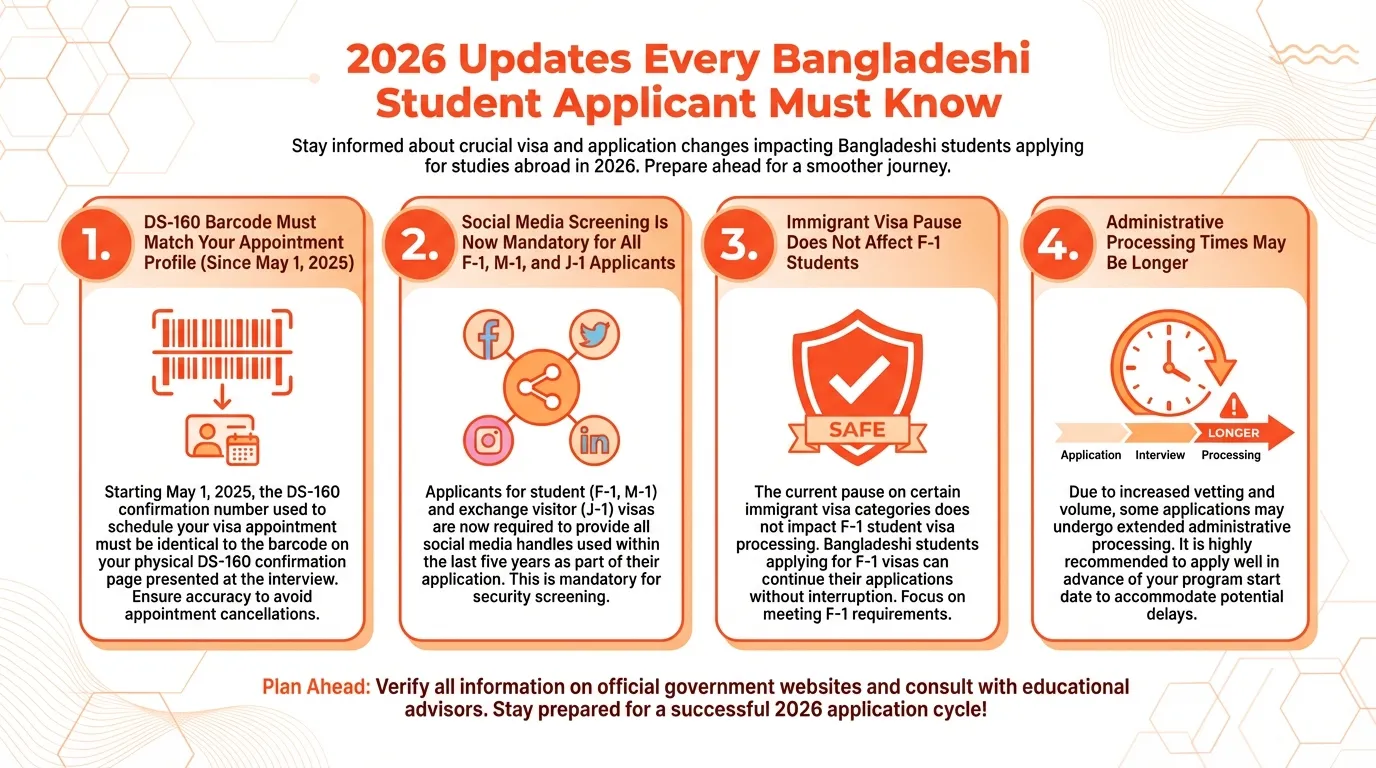
1. DS-160 Barcode Must Match Your Appointment Profile (Since May 1, 2025)
If the barcode on your printed DS-160 confirmation does not exactly match the barcode you used when scheduling your appointment on ustraveldocs.com, you will be denied entry to the consular section. Double-check this before your interview day. If you updated your DS-160 after booking the appointment, follow the embassy’s instructions for updating your DS-160 number.
2. Social Media Screening Is Now Mandatory for All F-1, M-1, and J-1 Applicants
All student and exchange visitor visa applicants must now submit their social media handles as part of the DS-160 form. Consular officers review public-facing accounts. Remove or make private any content that could be misinterpreted — political commentary, posts that could suggest intent to remain in the US, or content that contradicts your stated study plans. MMS Global has a full breakdown of how this works in our guide: US Student Visa Social Media Screening: Complete Guide for F-1, M-1 & J-1 Applicants.
3. Immigrant Visa Pause Does Not Affect F-1 Students
Since January 21, 2026, the US Department of State has paused immigrant visa (green card) issuances for Bangladeshi nationals. This does not affect F-1, M-1, or J-1 student visa applications. Your student visa interview will proceed normally. The pause only affects permanent residence applications. Source: US Embassy Bangladesh visa page.
4. Administrative Processing Times May Be Longer
Under the current political climate, some student visa applications from Bangladesh face additional administrative processing (221(g)) after the interview. This does not mean a denial — it means additional review is needed. Administrative processing can take two to six weeks or longer. Do not make irreversible plans (booking flights, giving notice at your job) until your visa is physically in your passport.
How to Present Yourself: Communication and Appearance
- Dress code: Wear conservative, professional clothing. Men should wear a collared shirt with dress trousers. Women should wear a formal blouse, salwar kameez, or a knee-length skirt. Avoid bold patterns, heavy jewellery, or anything that could distract from your answers. Your appearance signals that you take the process seriously.
- Pace and clarity: Speak at a moderate, steady pace. The officer sees hundreds of applicants daily — clarity matters more than eloquence. Do not rush through answers, and do not ramble beyond what was asked.
- Honesty above everything: Consular officers are trained to identify inconsistencies. If your bank statements show a large recent deposit, the officer will ask about it. If you have a prior visa denial (from any country), you must disclose it on your DS-160. Attempting to hide anything almost always ends in a refusal and can result in a permanent ban.
What Happens After the Interview
If approved: The officer will retain your passport for visa stamping. You will receive an SMS and email notification when your passport is ready for collection at the pickup location you selected during scheduling. Normal processing takes three to five business days. Track your passport status through the CEAC case status tool.
If additional processing is required (221(g)): You will receive a notice asking for additional documents or informing you that your case is under administrative review. Submit any requested documents at your selected pickup location — do not mail them directly to the embassy. Write your case number on every document. Check your case status regularly at ceac.state.gov.
If refused: The officer will return your passport immediately and provide a refusal slip citing the section of law under which you were refused. The most common refusal ground for student visa applicants is Section 214(b) — failure to demonstrate sufficient ties to Bangladesh and intent to return. You may reapply at any time, but your circumstances must have materially changed. Reapplying without addressing the original reason for refusal almost always results in a second refusal.
US Embassy Dhaka — Key Contact Information
| Detail | Information |
|---|---|
| Address | Madani Avenue, Baridhara, Dhaka-1212 |
| Phone | +880 2 5566-2000 |
| Appointment scheduling | ustraveldocs.com/bd |
| Case status tracking | ceac.state.gov |
| Rescheduling | Within 12 months of MRV fee payment |
| Document pickup locations | Dhaka, Chittagong, Sylhet |
| Interview support email | [email protected] |
Frequently Asked Questions About the US Embassy Interview in Dhaka
Start Your US Study Journey with Expert Guidance
The US Embassy interview in Dhaka is a process that rewards thorough preparation. If you are still in the early stages — researching universities, understanding admission requirements, or preparing your financial documents — MMS Global’s counsellors work with Bangladeshi students from initial shortlisting through to visa approval.
Explore our full Study in USA guide for a complete overview of universities, costs, scholarships, and post-study work options. When you are ready to take the next step, book a free counselling session with our Dhaka or Sylhet team.