
Canada is one of the most popular study destinations for Bangladeshi students — and for good reason. With world-class universities, a 3-year Post-Graduation Work Permit (PGWP), and a realistic pathway to Permanent Residency, Canada offers far more long-term value than what the tuition sticker price suggests.
But let’s be honest: Canada is not cheap by default. According to Statistics Canada, the average international undergraduate tuition in 2025–2026 is CAD 41,746 per year — that’s roughly BDT 38–40 lakh annually at current exchange rates. For most Bangladeshi families, that number is a dealbreaker before the conversation even starts.
The good news? That average is misleading. Choose the right province, the right institution type, and the right funding strategy, and you can cut that total by 40–60%. This guide breaks down exactly how to do that — with 2026-updated figures, real university comparisons, and a complete year-one budget you can take to your parents tonight.
Why Canada Still Makes Sense for Bangladeshi Students in 2026
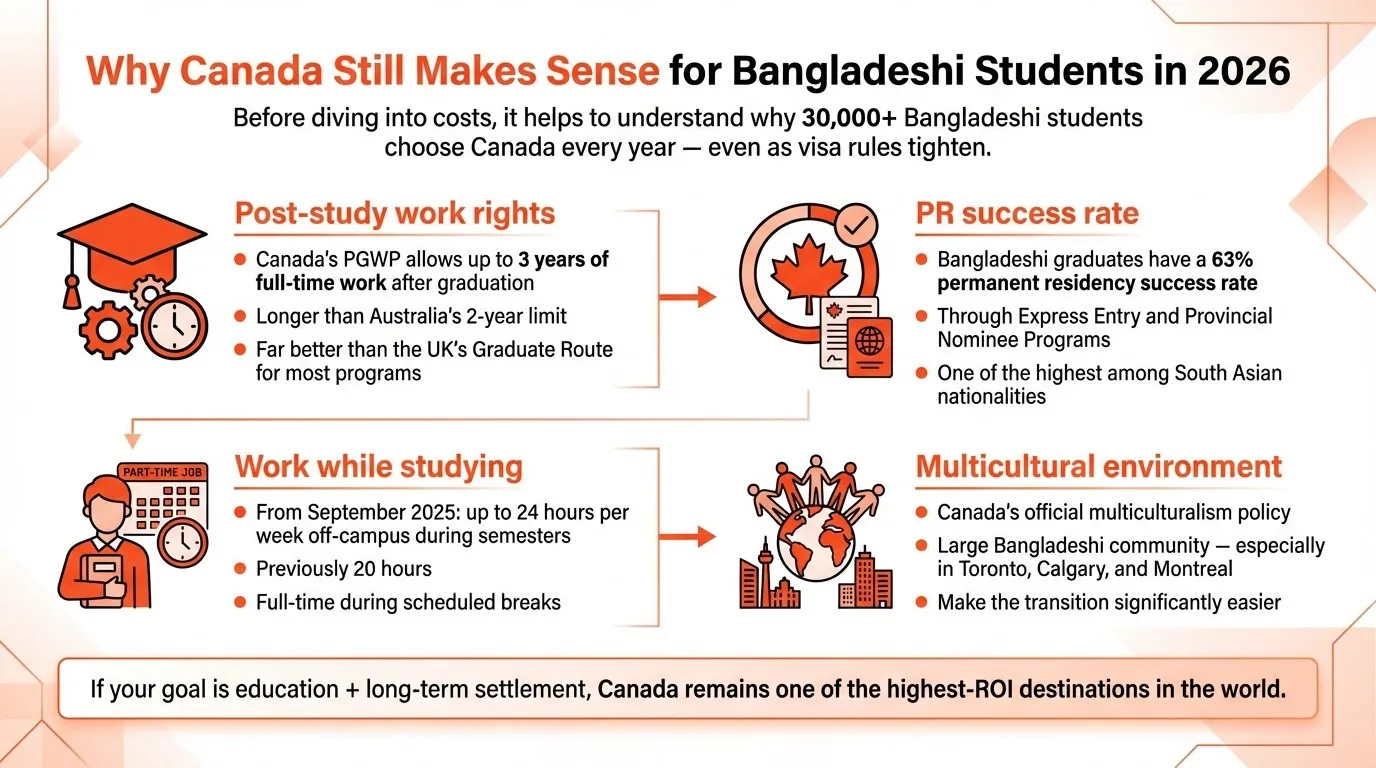
Before diving into costs, it helps to understand why 30,000+ Bangladeshi students choose Canada every year — even as visa rules tighten.
- Post-study work rights: Canada’s PGWP allows up to 3 years of full-time work after graduation — longer than Australia’s 2-year limit and far better than the UK’s Graduate Route for most programs.
- PR success rate: Bangladeshi graduates have a 63% permanent residency success rate through Express Entry and Provincial Nominee Programs — one of the highest among South Asian nationalities.
- Work while studying: From September 2025, international students can work up to 24 hours per week off-campus during semesters (previously 20 hours) and full-time during scheduled breaks.
- Multicultural environment: Canada’s official multiculturalism policy and large Bangladeshi community — especially in Toronto, Calgary, and Montreal — make the transition significantly easier.
If your goal is education + long-term settlement, Canada remains one of the highest-ROI destinations in the world.
Understanding the Real Cost of Studying in Canada in 2026
Many students focus on tuition alone. That’s a mistake. Your true cost of studying in Canada includes five components:
| Cost Component | Annual Estimate (CAD) | Annual Estimate (BDT~approx.) |
|---|---|---|
| Tuition (affordable university) | CAD 5,500 – 22,000 | BDT 5 – 20 lacs |
| Accommodation | CAD 8,000 – 14,000 | BDT 7 – 13 lacs |
| Food & Groceries | CAD 3,000 – 4,500 | BDT 2.7 – 4 lacs |
| Health Insurance | CAD 600 – 900 | BDT 55,000 – 82,000 |
| Transport | CAD 800 – 1,200 | BDT 73,000 – 1.1 lacs |
| Books & Miscellaneous | CAD 1,000 – 2,000 | BDT 92,000 – 1.8 lacs |
| Total Year-One Budget | CAD 19,000 – 44,600 | BDT 17 – 40 lacs |
Important 2026 Update: If you apply for a Canadian student visa after September 1, 2025, you must now show proof of CAD 22,895 for living expenses for one person — in addition to your first year’s tuition and return travel costs. This is a significant increase from earlier requirements and is something many Bangladesh-based consultancies are still quoting the old figure for. Make sure your financial documentation reflects the current threshold.
Colleges vs. Universities: The Biggest Cost-Saving Decision You’ll Make
Most Bangladeshi students default to applying to universities. But Canadian colleges (polytechnics and community colleges) offer a strategic advantage that competitors rarely explain clearly:
| Factor | Universities | Colleges |
|---|---|---|
| Average International Tuition | CAD 20,000 – 41,000/year | CAD 10,000 – 20,000/year |
| Program Duration | 3–4 years (UG) | 1–3 years (Diploma/PG Diploma) |
| PGWP Eligibility | Yes (up to 3 years) | Yes (up to 3 years) |
| Admission Requirements | Stricter | More flexible |
| Path to PR | Express Entry / PNP | Express Entry / PNP |
| Co-op Programs | Available at select schools | Very common |
Key insight: A 2-year college diploma and a 4-year university degree can lead to the same PGWP duration (3 years) if the program qualifies. For cost-conscious Bangladeshi students, a college diploma in a high-demand field like Cybersecurity, Data Analytics, or Business Management can cost half the price of a university degree while opening the same PR doors.
The 5 Cheapest Provinces for Bangladeshi Students in 2026
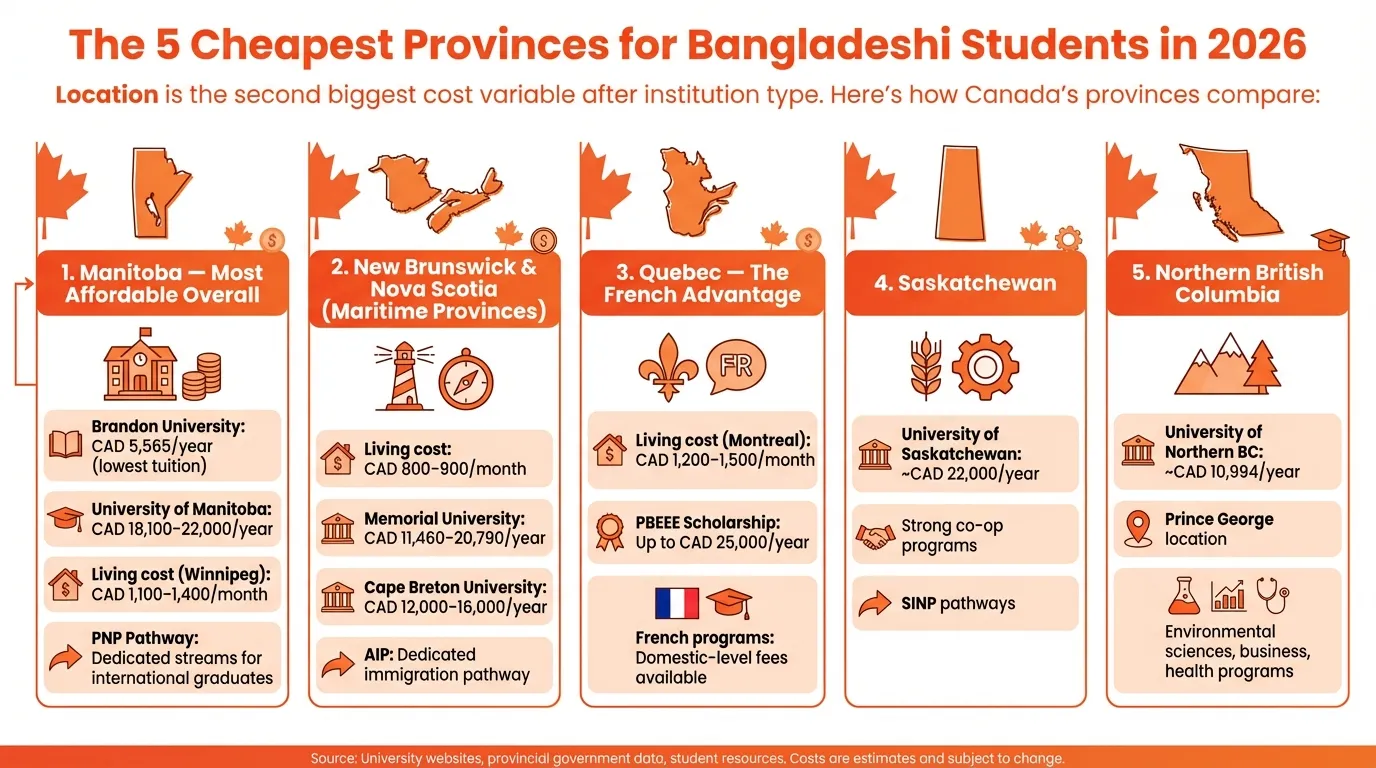
Location is the second biggest cost variable after institution type. Here’s how Canada’s provinces compare:
1. Manitoba — Most Affordable Overall
Manitoba offers the best combination of low tuition, low living costs, and strong Provincial Nominee Program (PNP) pathways. Winnipeg — the capital — is significantly cheaper to live in than Toronto or Vancouver.
- Brandon University: Average tuition ~CAD 5,565/year for international students — the lowest of any accredited Canadian university.
- University of Manitoba: CAD 18,100–22,000/year for undergraduates.
- Average monthly living cost (Winnipeg): CAD 1,100–1,400.
- PNP Pathway: Manitoba PNP has dedicated streams for international graduates.
2. New Brunswick & Nova Scotia (Maritime Provinces)
The Maritime Provinces offer some of the lowest living costs in Canada. Moncton, New Brunswick is particularly affordable at around CAD 800–900/month for a single student.
- Memorial University of Newfoundland (MUN): Tuition from CAD 11,460–20,790/year — one of the most affordable DLI options with full degree programs.
- Cape Breton University (CBU): Tuition from ~CAD 12,000–16,000/year, known for community-oriented support for international students.
- Atlantic Immigration Program (AIP): The Maritime Provinces offer a dedicated immigration pathway for international graduates.
3. Quebec — The French Advantage
Quebec’s education subsidy system means that students enrolled in French-taught programs at regional universities can access significantly reduced tuition rates — sometimes approaching domestic-level fees. Quebec hosts over 11 universities and 60+ colleges.
- Living cost (Montreal): CAD 1,200–1,500/month.
- Quebec Provincial Government Scholarship (PBEEE): Up to CAD 25,000/year for doctoral programs.
- Strategic note: If you’re willing to study in French (or in bilingual programs), Quebec offers by far the most generous cost reduction available to Bangladeshi students in all of Canada.
4. Saskatchewan
- University of Saskatchewan: ~CAD 22,000/year — mid-range but with strong co-op programs and Saskatchewan Immigrant Nominee Program (SINP) pathways.
- Low living costs in Saskatoon compared to major cities.
5. Northern British Columbia
- University of Northern British Columbia (UNBC): Average tuition ~CAD 10,994/year — significantly cheaper than UBC or SFU while still in BC.
- Located in Prince George, UNBC offers strong environmental sciences, business, and health programs.
Top Budget-Friendly Canadian Universities for Bangladeshi Students (2026)
Here is an updated comparison of the most affordable, DLI-certified universities that are popular with Bangladeshi students:
| University | Province | Avg. International Tuition (CAD/year) | PGWP Eligible | Notable For |
|---|---|---|---|---|
| Brandon University | Manitoba | ~5,565 | ✅ | Lowest tuition in Canada |
| Memorial University of Newfoundland | NL | ~11,460 – 20,790 | ✅ | Affordable full degrees |
| University of Northern BC (UNBC) | BC | ~10,994 | ✅ | Environmental & Science |
| Cape Breton University | Nova Scotia | ~12,000 – 16,000 | ✅ | Atlantic Immigration pathway |
| University of Winnipeg | Manitoba | ~13,695 | ✅ | Business & Humanities |
| Concordia University | Quebec | ~22,899 – 32,120 | ✅ | Diverse programs, Montreal |
| University of Saskatchewan | Saskatchewan | ~22,000 | ✅ | Co-op programs, SINP |
| University of Manitoba | Manitoba | ~18,100 – 22,000 | ✅ | Research-intensive |
Source: Respective university websites and Statistics Canada 2025–2026 data. Fees vary by program; verify directly with the institution.
Top Affordable Colleges in Canada for Bangladeshi Students
For students who want faster entry into the job market and a lower upfront investment, these colleges offer strong diploma and post-graduate programs:
| College | Province | Avg. Tuition (CAD/year) | Popular Programs |
|---|---|---|---|
| Loyalist College | Ontario | ~16,308 | Business, IT, Health |
| Centennial College | Ontario | ~15,000 – 18,000 | Digital Marketing, Nursing |
| George Brown College | Ontario | ~16,000 – 20,000 | Hospitality, Cybersecurity |
| Sheridan College | Ontario | ~16,000 – 19,000 | Animation, Business |
| Northern College | Ontario | ~13,000 – 15,000 | Trades, Technology |
College tuition is typically 30–50% lower than university tuition, and most 2-year diploma programs qualify for a 3-year PGWP — making them a highly cost-effective route.
Scholarship Opportunities for Bangladeshi Students in 2026
Scholarships can dramatically reduce the cost of studying in Canada. Here are the most relevant options for Bangladeshi students:
Government Scholarships
- Vanier Canada Graduate Scholarships: CAD 50,000/year for 3 years — for doctoral students with strong academic records and leadership potential.
- Ontario Trillium Scholarship: CAD 40,000/year, renewable for up to 4 years — for doctoral students at Ontario universities.
- Quebec PBEEE Scholarship: CAD 25,000/year for doctoral programs in Quebec.
- Canadian Commonwealth Scholarship Program: For students from Commonwealth countries including Bangladesh — check through the Association of Commonwealth Universities.
University-Level Scholarships
- Most Canadian universities offer entrance scholarships ranging from CAD 1,000 to CAD 15,000 for international students with strong academic records.
- Many colleges offer automatic merit-based bursaries — no separate application needed.
Strategic Tip for Bangladeshi Students
Apply to Manitoba universities specifically. The Manitoba Graduate Scholarship (MGS) and several Brandon University awards are available to international students and are less competitive than Ontario or BC equivalents, as fewer applicants target these provinces.
Part-Time Work: Reducing Your Cost While Studying
Since September 2025, international students in Canada can work up to 24 hours per week off-campus during academic sessions, up from the previous 20-hour limit. During scheduled breaks (winter, summer), you can work full-time with no restriction.
Realistic monthly earnings estimate:
- Working 24 hours/week at CAD 15–18/hour (provincial minimum wages vary)
- Monthly earnings: approximately CAD 1,440 – 1,728
- Annual earnings (10 months): approximately CAD 14,400 – 17,280
This is enough to cover a significant portion of living costs. Combined with affordable accommodation in Manitoba or the Maritime Provinces, part-time work can make your Canadian education genuinely self-sustaining on a monthly basis.
Popular part-time jobs for Bangladeshi students in Canada:
- Teaching/Research Assistant (on-campus): CAD 18–25/hour
- Retail/Customer Service: CAD 15–18/hour
- Freelance/Remote work: CAD 20–40/hour (digital skills in high demand)
- Food & Hospitality: CAD 15–17/hour + tips
- Rideshare/Delivery: CAD 15–20/hour (flexible hours)
Important: Your work permit eligibility is tied to your study permit. You must be enrolled in a full-time program at a Designated Learning Institution (DLI) to maintain your work authorization.
Canada Student Visa (Study Permit) — Updated Costs & Requirements for 2026
Cost of the Study Permit
| Fee | Amount (CAD) |
|---|---|
| Study Permit Application | CAD 150 |
| Biometrics | CAD 85 |
| Medical Examination (if required) | CAD 200–300 |
| Total Approximate Visa Cost | CAD 435–535 |
Key Documents Required
- Letter of Acceptance from a DLI in Canada
- Proof of financial support: CAD 22,895 for living expenses (for 1 person, if applying after September 1, 2025) + tuition for Year 1 + return travel costs
- Valid passport (minimum 6 months validity beyond intended stay)
- Statement of Purpose (SOP/Letter of Explanation)
- Academic transcripts and certificates
- English proficiency proof (IELTS minimum 6.0–6.5 overall, or TOEFL iBT 90+)
- Clean criminal record certificate
- Medical examination results (if required by IRCC)
Processing Time
Canadian study permit applications from Bangladesh typically take 4–8 weeks via regular processing. Apply at minimum 3 months before your program start date. SDS (Student Direct Stream) is no longer available as a separate fast-track as of late 2024; however, complete applications with strong financials process faster.
For a detailed step-by-step visa checklist, read our guide: Canada Student Visa from Bangladesh — Complete Guide
Co-op Programs: The Cost-Saving Strategy Most Students Miss
Canadian co-op programs integrate paid work placements directly into your degree. This means you earn a full professional salary — not a part-time minimum wage — while completing your studies. This is arguably the most powerful cost-reduction strategy available.
How it works:
- Co-op programs alternate between study terms and full-time paid work terms.
- Work terms typically pay CAD 18–35/hour depending on your field.
- A student in a 4-year co-op engineering program can earn CAD 60,000–100,000 in total co-op income over the degree period.
Best co-op programs for Bangladeshi students:
- University of Waterloo — Canada’s #1 co-op program (Tech, Engineering, Math). Graduates earn CAD 75,000–85,000 starting salary. Large Bangladeshi student network in Ontario.
- Simon Fraser University (SFU) — Strong tech co-op with Vancouver industry connections. Tuition from CAD 13,000/year.
- University of Saskatchewan — Co-op available in Engineering and Business with SINP PR pathway.
- Sheridan College — Animation and Business co-op programs with strong employer partnerships.
Important: Co-op work terms count as part of your PGWP eligibility period, potentially extending your post-graduation work authorization.
Your 12-Month Timeline: From Decision to Arrival in Canada
Planning ahead is the single biggest factor in keeping costs down. Here’s your recommended preparation timeline:
| Month | Action |
|---|---|
| Month 1–2 | Research universities/colleges. Compare programs and tuition by province. Target Manitoba, Maritime Provinces, or Quebec for cost savings. |
| Month 2–3 | Take IELTS or TOEFL. (Target IELTS 6.5 overall for most universities.) |
| Month 3–5 | Apply to 4–6 institutions. Include at least 2 safety schools (Brandon U, MUN, UNBC). Apply for scholarships simultaneously. |
| Month 5–6 | Receive offers. Compare packages (tuition + scholarship + location). Accept preferred offer. |
| Month 6–8 | Begin student visa application. Gather financial documents, SOP, transcripts. |
| Month 8–9 | Receive study permit. Arrange accommodation (early is critical — campus housing fills fast). |
| Month 9–10 | Book flights. Convert funds to CAD. Open bank account (many Canadian banks allow pre-arrival account opening). |
| Month 10–12 | Arrive in Canada. Register for classes, set up SIN (Social Insurance Number), find part-time work. |
Starting this process now? Book a free 30-minute consultation with an MMS Global advisor — we work with students from Dhaka and Sylhet and have helped hundreds navigate this exact timeline.
Bangladeshi Community & Support Resources in Canada
One concern Bangladeshi students often have is: “Will I feel alone?” The short answer is no.
- Toronto has one of the largest Bangladeshi diaspora communities outside Bangladesh, concentrated in areas like Scarborough, Mississauga, and Brampton.
- Calgary has a growing Bangladeshi community with strong cultural associations and mosques.
- Montreal has a smaller but tight-knit Bangladeshi student community, particularly at McGill and Concordia.
Most Canadian universities also have:
- International Student Offices that provide settlement support, academic advising, and emergency funds.
- Muslim Student Associations with halal food resources and prayer spaces.
- Bengali/South Asian Student Associations for cultural connection and networking.
- Free academic and mental health counselling — genuinely utilised and high quality.
Frequently Asked Questions (FAQ)
Cheapest Way to Study in Canada from Bangladesh: Summary
The cheapest way to study in Canada from Bangladesh in 2026 comes down to three strategic choices:
1. Choose the right province: Manitoba, New Brunswick, Nova Scotia, and Quebec offer dramatically lower costs than Ontario or British Columbia.
2. Choose colleges or budget-friendly universities: Brandon University, Memorial University of Newfoundland, UNBC, and Cape Breton University offer quality degrees at 40–60% below the national average tuition.
3. Layer your cost-saving strategies: Combine scholarships + part-time work + co-op programs + affordable accommodation. Students who do all three can realistically reduce their out-of-pocket cost by CAD 15,000–25,000 per year.
Canada remains one of the best long-term investments a Bangladeshi student can make — but the quality of your outcome depends entirely on the quality of your planning.