
If you’re studying in Australia on a Student Visa (Subclass 500), you must have Overseas Student Health Cover (OSHC). This insurance is mandatory under Visa Condition 8501.
The Department of Home Affairs requires all international students to maintain health insurance for their entire stay. Without valid OSHC, your visa application won’t be processed, and letting coverage lapse can result in visa cancellation.
This guide covers everything you need to know about OSHC in 2026 — what it covers, costs, provider comparisons, and the claims process.
What is OSHC (Overseas Student Health Cover)?
Overseas Student Health Cover (OSHC) is health insurance required for all Student Visa (Subclass 500) holders. It’s a private insurance product covering medical and hospital care for international students in Australia.
OSHC is government-regulated, with only approved insurers permitted to offer it. This ensures all policies meet minimum coverage standards.
Who Needs OSHC?
Every holder of a Student Visa Subclass 500 is required to have OSHC.
- Primary Students: The individual applying for the visa to pursue a full-time course at an Australian education provider (university, vocational college, English language school, etc.).
- Family Members: If your visa includes dependent relatives—spouses or de facto partners, and dependent children under 18 or full-time students under 21—they must also have OSHC coverage. You can either:
- Purchase a single policy that covers you and your dependents, or
- Hold separate policies for each family member (though a combined family policy is usually simpler and often cheaper per person).
OSHC vs Medicare: Key Differences
One of the most common questions international students ask is why they can’t simply use Medicare. The answer lies in eligibility. Medicare is Australia’s universal public health insurance system, but it is reserved exclusively for Australian citizens, permanent residents, and citizens of countries with specific reciprocal healthcare agreements. Most international students do not qualify for Medicare under any circumstance.
| Feature | OSHC (Overseas Student Health Cover) | Medicare |
|---|---|---|
| Eligibility | Mandatory for Student Visa (Subclass 500) holders & dependents | Citizens, PR, some temporary residents |
| Cost | Paid by student (annual cost $623–$850+ for single) | Free for eligible residents |
| Hospital Cover | Covers shared ward accommodation in private/public hospitals (as per policy) | Covers public hospital treatment (often with waiting lists) |
| Outpatient Care | Covers GP visits, specialists, tests (often with co-pay) | Bulk-billed (free) GP visits, tests |
| Prescriptions | Covers some PBS medicines (significant co-payment applies) | Covers most PBS medicines ($7.30 standard) |
| Ambulance | Emergency ambulance covered (full or partial) | Not covered – often expensive out-of-pocket |
| Purpose | Mandatory visa compliance + essential health protection | Universal healthcare for residents |
OSHC Coverage: What’s Included?
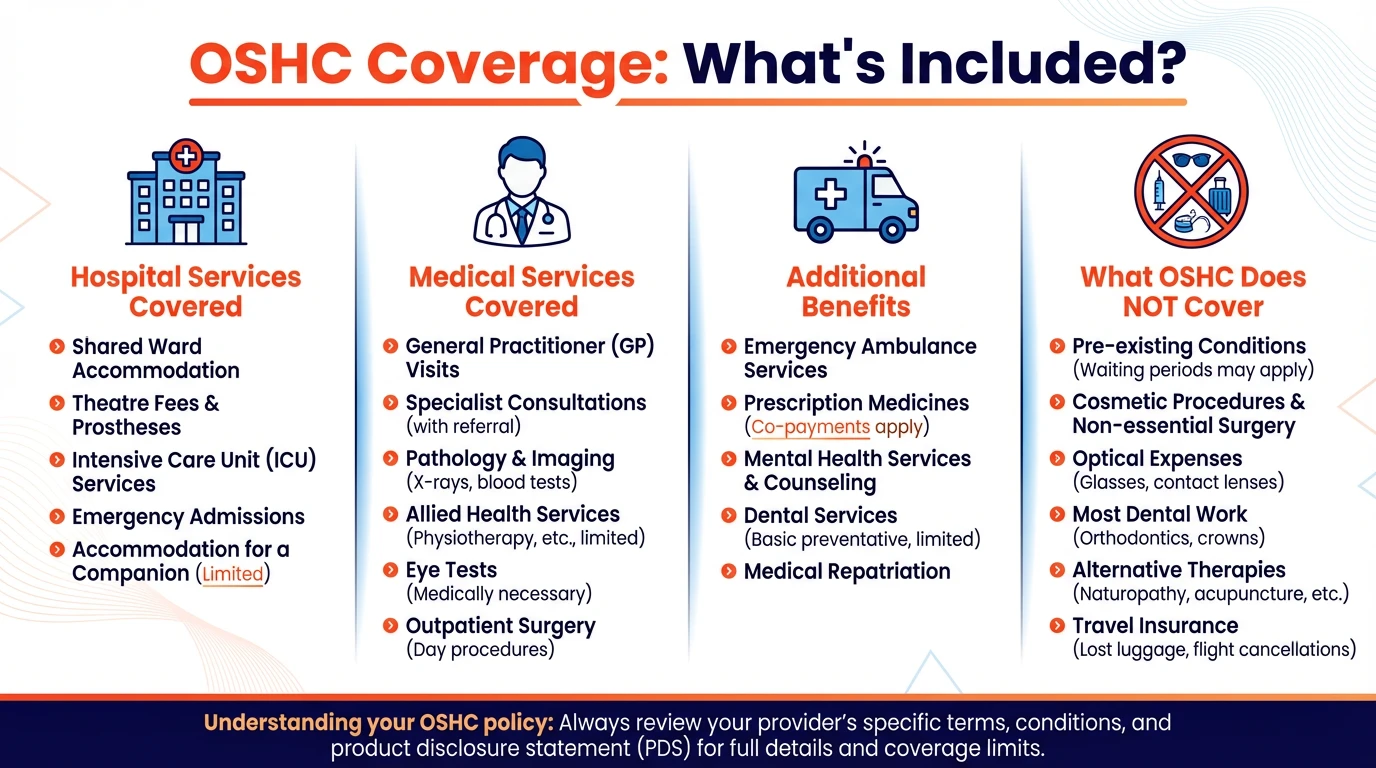
All government-approved OSHC policies must meet minimum coverage standards. Here’s what’s included in a standard policy.
Hospital Services Covered
OSHC covers inpatient services (overnight hospital stays). Key inclusions:
- Shared Ward Accommodation: Covers shared ward (2–4 beds) in public or private hospitals. Private rooms incur gap payments.
- Theatre Fees & Surgeon/Anaesthetist Costs: For surgery, OSHC covers:
- Theatre fees.
- Surgeon and anaesthetist fees up to 100% of the Medicare Benefits Schedule (MBS) rate. Charges above MBS rates result in gap payments.
- Intensive Care (ICU): ICU costs are covered, subject to policy limits.
- Emergency & Non-Emergency Admissions: Covers both emergency and planned procedures requiring hospitalization.
- Accommodation for Accompanying Person: May cover a companion’s shared ward stay for certain procedures.
Without insurance, a single hospital night can cost $2,000–$5,000. OSHC protects you from these costs.
Medical Services Covered
OSHC covers outpatient medical services for routine healthcare:
- GP Visits: Covers most or all of the scheduled benefit for GP consultations. Some providers offer “gap-free” visits at network clinics.
- Specialist Consultations: Covers visits to specialists when GP-referred, usually at 100% of MBS rate. Gap payments apply if specialists charge more.
- Pathology & Diagnostic Imaging: Covers blood tests, X-rays, ultrasounds, CT scans, MRIs, and other diagnostic tests.
- Allied Health (Limited): Some providers offer limited cover ($50–$100/year) for physiotherapists, psychologists, or dietitians.
- Eye Tests: One standard eye exam per year. Glasses, contacts, and laser surgery are not covered.
- Outpatient Surgery: Covers minor procedures in clinics without overnight stays.
Additional Benefits
OSHC includes extra benefits beyond core coverage:
- Emergency Ambulance: Mandatory coverage for emergency ambulance transport. Without cover, ambulance rides cost $500–$2,000+.
- Prescription Medicines: Subsidies for PBS-listed prescriptions. You pay an OSHC co-payment (typically $30–$45) instead of full price. Non-PBS prescriptions are not subsidized.
- Mental Health Services: Many providers offer rebates for counselling sessions ($50–$100 per session, up to yearly limits).
- Dental (Basic): Limited cover for one or two preventative procedures per year (annual limits $100–$300). Major dental work is excluded.
- Repatriation: Covers medical transport back to your home country if specialized treatment isn’t available in Australia.
What OSHC Does NOT Cover
Important OSHC exclusions to know:
- Pre-existing Conditions: 12-month waiting period for pre-existing conditions. Always declare conditions honestly.
- Cosmetic Procedures: Cosmetic surgery, botox, and liposuction are not covered.
- Optical Expenses: Glasses, contact lenses, and laser eye surgery are excluded.
- Most Dental Work: Only basic preventative dental is covered. Major dental work (crowns, bridges, implants, root canal, orthodontics) is not covered.
- Routine Check-ups Beyond Basic: Covers necessary GP visits, not unlimited wellness check-ups.
- Non-PBS Prescription Medicines: You pay full cost for non-subsidized prescriptions.
- Out-of-Network Gap Payments: Choosing providers outside your network or who charge above MBS rates means you pay the entire gap.
- Alternative Therapies: Acupuncture, chiropractic, osteopathy, naturopathy, and massage are generally not covered.
- Travel Insurance: OSHC only covers you in Australia. Travel outside requires separate insurance.
- Vaccinations (Non-Mandatory): Routine vaccinations not required for entry are usually out-of-pocket.
Always read your Policy Document and Product Disclosure Statement (PDS) for specific limits and exclusions.
OSHC Cost: How Much Does Student Health Insurance Cost?
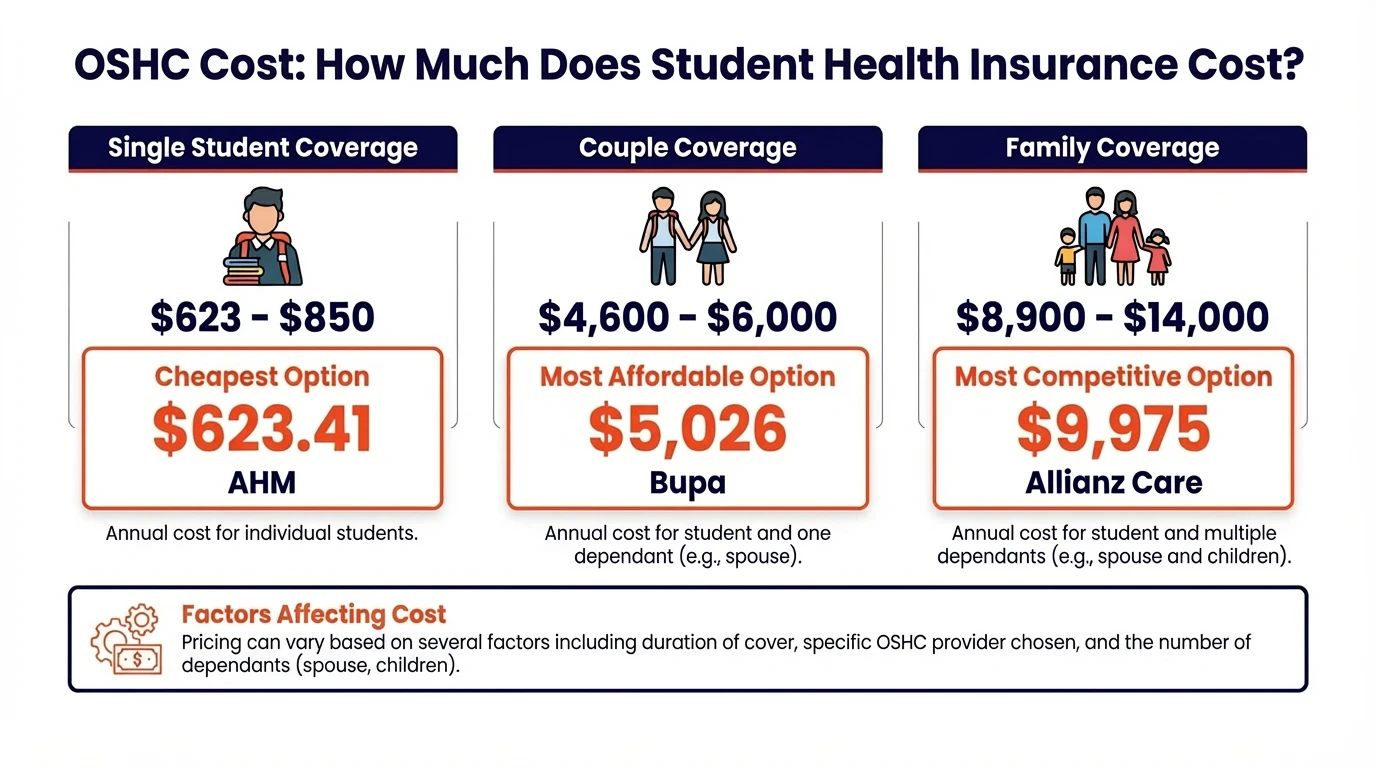
In 2026, OSHC cost ranges from approximately $623 per year for a single student to over $14,000 per year for a large family.
| Coverage Type | Annual Cost Range (2026) | Cheapest Provider | Approximate Cheapest Price |
|---|---|---|---|
| Single Student | $623 – $850 | AHM | $623.41 per year |
| Couple | $4,600 – $6,000 | Bupa | $5,026 per year |
| Family | $8,900 – $14,000 | Allianz Care | $9,975 per year |
Top OSHC Providers in Australia (2026 Comparison)
The Australian Government has approved five private health insurers to offer OSHC. Each provider meets the minimum coverage requirements, but they differentiate themselves through pricing, digital services, provider networks, and additional benefits. Here’s a detailed look at each OSHC provider to help you compare OSHC options and find the best fit for your situation.
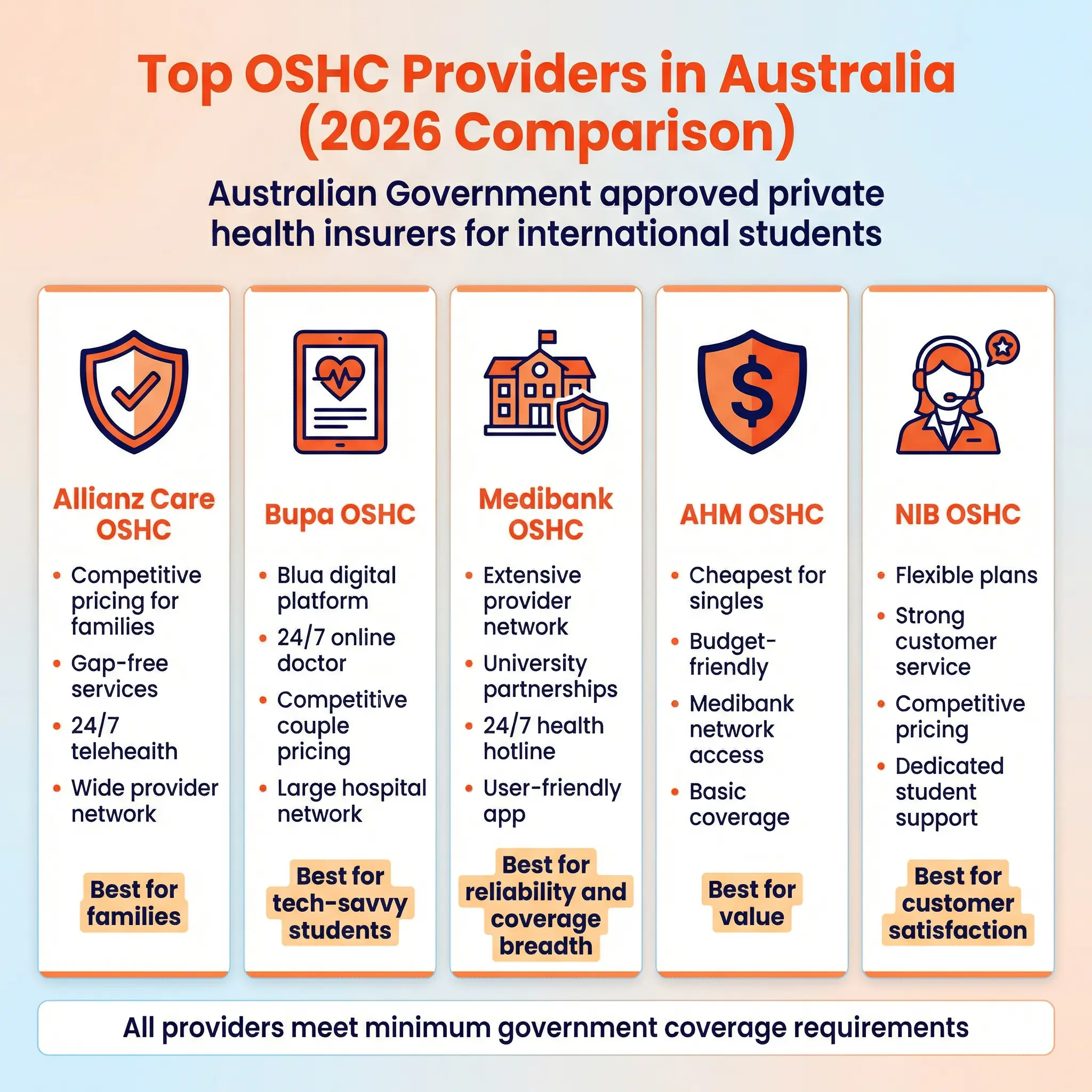
OSHC Provider Comparison Table
| Provider | Single/Year | Couple/Year | Family/Year | Key Feature | Best For |
|---|---|---|---|---|---|
| AHM | ~$623 | ~$5,200 | ~$10,500 | Lowest single price | Budget-conscious singles |
| Allianz Care | ~$680 | ~$5,100 | ~$9,975 | Gap-free services, 24/7 telehealth | Families |
| Bupa | ~$800 | ~$5,026 | ~$11,200 | Blua digital platform, 24/7 online doctor | Couples |
| Medibank | ~$830 | ~$5,500 | ~$12,800 | Largest network, university partnerships | Comprehensive coverage seekers |
| NIB | ~$720 | ~$5,350 | ~$11,000 | Flexible plans, strong customer service | Value with service quality |
Note: Prices are approximate 2026 figures and may vary based on course duration and payment frequency. Always confirm current pricing directly with the provider.
How to Choose the Right OSHC Plan
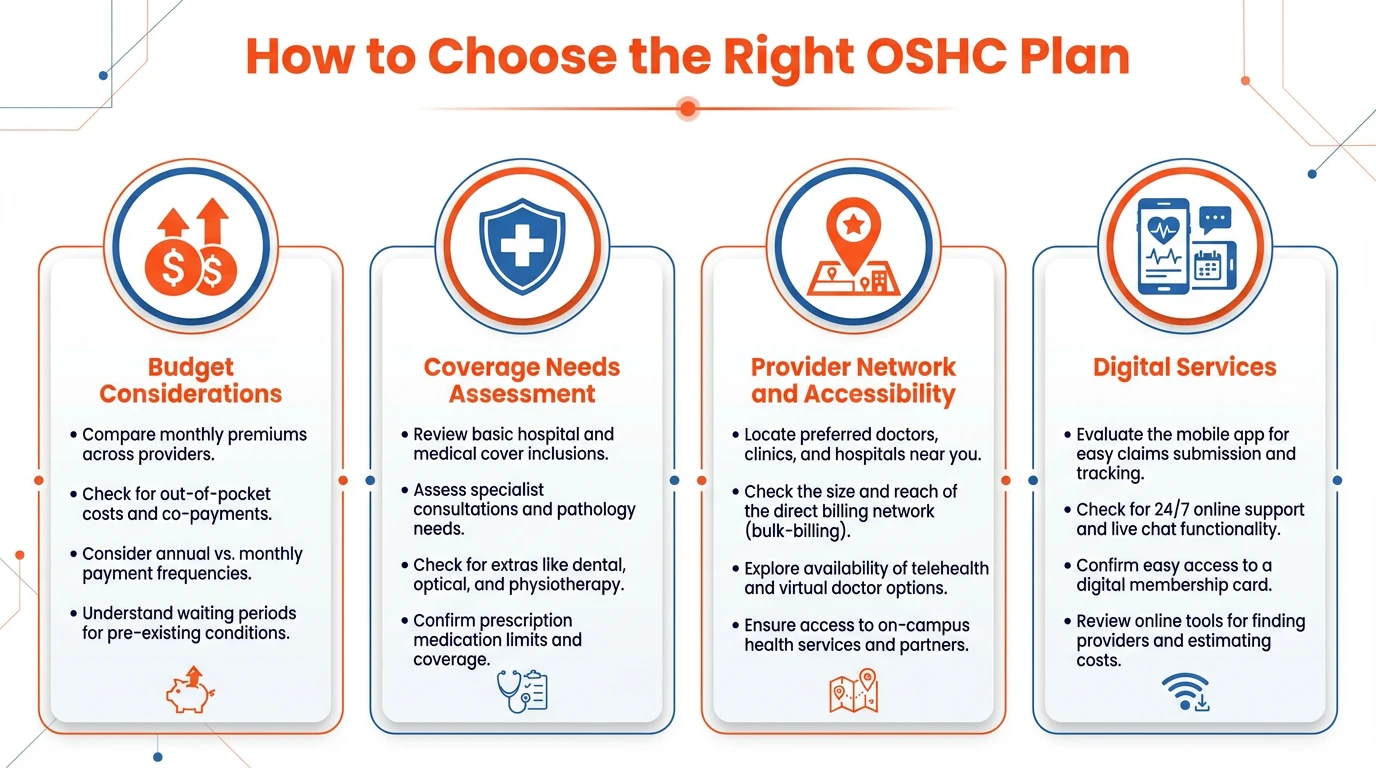
Choosing the best OSHC for students involves more than simply picking the cheapest option. Your health insurance will be your primary safety net for the entire duration of your stay in Australia, so it’s worth investing time in selecting a plan that genuinely fits your needs. Here are the key factors to consider when deciding how to select health insurance for your student visa.
How to Apply for OSHC
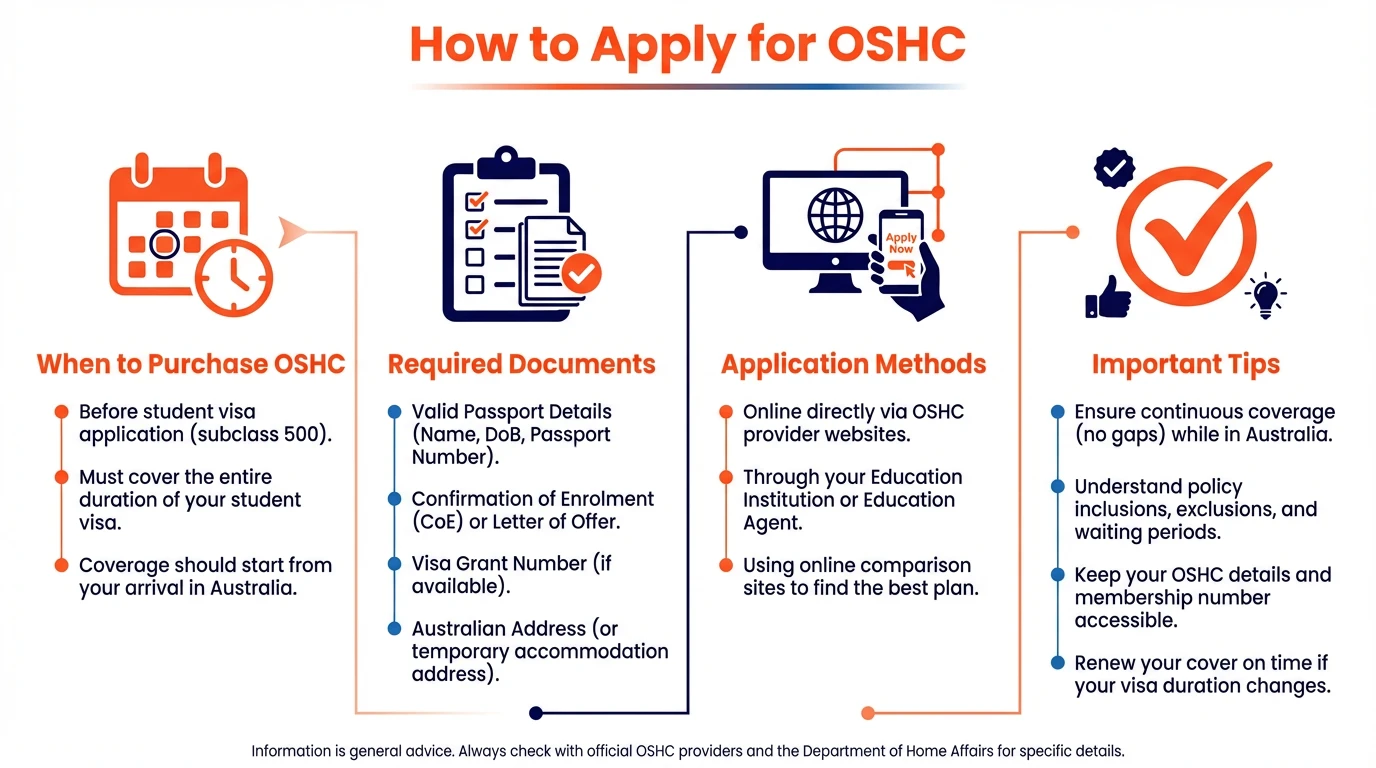
The OSHC application process is straightforward, but timing and documentation are critical. Buying student health insurance at the right time ensures your visa application isn’t delayed and that you’re covered from the moment you step off the plane. Here’s your step-by-step guide to how to apply for OSHC.
Frequently Asked Questions About OSHC
Securing Your Health Insurance for Australia Student Visa
Navigating OSHC doesn’t have to be complicated. First, understand that OSHC is mandatory under Visa Condition 8501 — no shortcuts exist. Second, compare providers: AHM for affordable single coverage, Bupa for couples, Allianz Care for families, and Medibank or NIB for comprehensive networks. Third, purchase before lodging your visa application, ensuring coverage starts on arrival and extends through your visa period.
Once in Australia, register with a GP near campus, download your provider’s app, and familiarise yourself with claims before you need them. Set policy expiry reminders. If circumstances change — visa extension, new family member, or provider switch — act promptly to maintain continuous coverage.
Visit the official websites of Australia’s approved OSHC providers to compare quotes and find the right plan for your needs:
- AHM OSHC — Best for budget-conscious single students
- Allianz Care OSHC — Best for families
- Bupa OSHC — Best for couples and digital-first students
- Medibank OSHC — Best for comprehensive coverage and university partnerships
- NIB OSHC — Best for value with strong customer service
Don’t delay – purchase your OSHC today and take the first step toward a smooth and secure student visa application.